
What Are Stoicism and Buddhism? Understanding Their Core Teachings
Stoicism and Buddhism developed in different historical and cultural settings, yet both became traditions of practical training. They ask people to examine their habits, understand what causes distress, and change how they respond to experience. The main difference is their starting point. Stoicism centers on virtue and rational judgment, while Buddhism focuses on understanding suffering and following a path toward liberation.
What Is Stoicism? The Philosophy of Virtue and Rational Living
Stoicism began in Athens in the early third century BCE and later became influential in Rome. Its major surviving teachers include Epictetus, Seneca, and Marcus Aurelius. At the heart of Stoic philosophy is the idea that virtue is the foundation of a good life. Wealth, popularity, health, and professional success may be valuable, but they don't determine whether someone acts wisely or morally.
Stoics organize virtuous character around four central virtues:
- Wisdom:
Understanding situations clearly and making sound decisions. - Courage:
Doing what is right despite fear, uncertainty, or discomfort. - Justice:
Treating others fairly and fulfilling social responsibilities. - Temperance:
Practicing moderation and resisting harmful impulses.
Another essential concept is the dichotomy of control, introduced in Epictetus's Enchiridion. Epictetus distinguishes between what depends on us, such as our judgments and choices, and what doesn't depend on us, such as other people's opinions or the final outcome of many events.
Consider a job interview. You can prepare carefully, communicate honestly, and make a genuine effort. You can't guarantee that the employer will choose you. Stoicism encourages you to focus on the quality of your preparation and conduct rather than treating the final decision as the measure of your worth.
Stoicism doesn't require passivity. You should still work to improve difficult circumstances. The point is to recognize the limits of your influence while taking responsibility for the choices that remain yours. The ancient Stoics also discussed Logos, the rational principle they believed ordered the cosmos. Their philosophy therefore involved a broader understanding of nature and human life, not simply a collection of techniques for reducing stress.
Stoicism’s emphasis on wisdom, virtue, and examining one’s beliefs also connects with Socrates’ philosophical approach. Read our guide to [Plato’s Apology: Summary, Arguments, Analysis & Socrates’ Defense] to explore Socrates’ views on wisdom, moral courage, and the examined life.
What Is Buddhism? The Path to Understanding and Ending Suffering
Buddhism originated in ancient India through the teachings associated with Gautama Buddha. It addresses a central question: Why do human beings experience suffering and dissatisfaction, and how can they become free from their underlying causes?
The Buddha's teachings include the Four Noble Truths, which explain suffering, its origin, its cessation, and the path leading toward that cessation.
Buddhist practice brings together ethical conduct, mental training, and wisdom. The Noble Eightfold Path provides guidance for developing these qualities through right view, intention, speech, action, livelihood, effort, mindfulness, and concentration.
Several concepts are especially important:
- Dukkha:
Suffering, dissatisfaction, or the unsatisfactory nature of conditioned existence. - Anicca:
Impermanence, the principle that conditioned things change. - Anatta:
Non-self, the teaching that no permanent, independent self can be found in the way people commonly assume. - Mindfulness:
Attending to experience with awareness rather than reacting automatically. - Meditation:
A range of practices that develop attention, concentration, and insight.
For example, imagine that a close friend cancels plans at the last minute. You might feel disappointed and begin thinking, "They don't respect me. This friendship means nothing."
A Buddhist approach could involve noticing the disappointment, observing the thoughts that follow, and examining the expectations or attachment intensifying the distress. You could then communicate your concerns thoughtfully instead of reacting immediately. Buddhism isn't limited to meditation or modern wellness techniques. Its different traditions include ethical commitments, philosophical teachings, and religious beliefs, including teachings about karma, rebirth, and liberation.
What Are the Main Goals of Stoicism and Buddhism?
Although both traditions address suffering and human conduct, they define their central goals differently.
| Aspect | Stoicism | Buddhism |
| Primary goal | Live virtuously according to reason and nature | Follow the path toward liberation from suffering |
| Central problem | Mistaken judgments and failure to live virtuously | Suffering sustained by craving, ignorance, and related conditions |
| Main emphasis | Wisdom, virtue, and responsible action | Ethical conduct, meditation, and liberating insight |
| Ideal outcome | A virtuous and flourishing life | Liberation, understood within Buddhist teachings |
Stoic tranquility is connected to sound judgment and virtuous living. Buddhist liberation involves a deeper transformation in how suffering, craving, and the nature of experience are understood. Neither tradition promises a life without pain, difficulty, or uncertainty. Both ask you to develop a wiser relationship with the realities you cannot completely avoid.
““Some things are in our control and others not.””
— Epictetus, Enchiridion (The Handbook), Section 1
Note on context: Stoicism teaches us to distinguish between what we can control—our judgments, choices, and actions—and what we cannot, such as other people’s opinions and many external events. Buddhism also examines how suffering arises and how mindfulness, ethical conduct, and letting go of attachment can help reduce it. Both traditions encourage self-awareness and a wiser response to life’s difficulties, though their philosophical foundations differ.
Key Takeaway: Stoicism emphasizes virtue, reason, and focusing on what is within our control. Buddhism emphasizes understanding suffering, cultivating mindfulness, and reducing craving and attachment. Both offer practical ways to develop greater awareness and respond to challenges more skillfully.
- Focus on your choices and actions rather than trying to control every outcome.
Stoicism and Buddhism on Suffering: Why We Struggle and How to Find Peace

Suffering is one of the clearest points of connection between these traditions. Both recognize that people can make difficult experiences harder through habitual reactions, but they explain the problem differently. Stoicism focuses on the judgments people make about events. Buddhism examines craving, ignorance, and the conditions that sustain suffering. These approaches can lead to similar practical questions: What am I reacting to? What assumptions am I making? What can I do differently?
How Stoicism Explains Suffering Through Judgments and Perceptions
According to Stoic philosophy, an external event and your judgment about that event aren't the same thing.
Suppose a colleague criticizes your work during a meeting. The criticism may be fair, unfair, or partly accurate. Your initial reaction might include embarrassment, anger, or defensiveness. A Stoic response involves examining what happened before deciding what it means.
You might ask yourself:
- Is the criticism accurate, inaccurate, or incomplete?
- Can I learn something useful from it?
- Am I treating another person's opinion as proof of my worth?
- What response would reflect wisdom, courage, justice, and temperance?
This approach doesn't mean that every painful feeling is a deliberate choice. People can experience immediate emotional and physical reactions without deciding to have them. The Stoic exercise is to examine the judgments that develop around an experience and avoid automatically endorsing every impression.
Stoicism also distinguishes virtue from external success. Losing a job, receiving criticism, or experiencing financial difficulty can create genuine problems, but these events don't automatically make someone morally worse. A person can still respond with honesty, courage, and sound judgment. This is the foundation of Stoic emotional resilience: not preventing every unpleasant experience, but developing the ability to respond thoughtfully when life becomes difficult.
How Buddhism Explains Suffering Through Craving and Ignorance
Buddhism approaches suffering through the Four Noble Truths. The second truth identifies craving as a central cause of suffering, while the broader Buddhist framework also examines ignorance and the conditions that sustain dissatisfaction. Consider the same workplace criticism. The initial sting may be followed by a chain of thoughts: "I must never look incompetent," "Everyone has to respect me," or "I can't be happy unless my work is praised."
The criticism is one experience. The demand that reality must conform to your expectations can become an additional source of distress. Buddhist practice encourages you to notice these reactions, observe how they change, and investigate the craving or aversion involved. You can acknowledge embarrassment without turning it into a permanent judgment about yourself.
The Buddhist concept of impermanence (Anicca) is relevant here. Feelings, thoughts, reputations, and circumstances change. Recognizing this doesn't make an unpleasant experience disappear, but it can weaken the assumption that a painful moment defines your entire life. Buddhism doesn't teach that all desire is necessarily harmful in the same way. The distinction between ordinary intentions and craving matters, as does the wider path of ethical conduct, meditation, and wisdom.
Stoicism vs Buddhism: Responding to a Difficult Life Event
Imagine that a long-term relationship ends unexpectedly. Both traditions offer ways to approach the loss, but they emphasize different questions.
| Situation | Stoic approach | Buddhist approach |
| Initial pain | Acknowledge the reaction and examine subsequent judgments | Notice the pain and observe how it develops |
| Fear of the future | Focus on responsible choices rather than trying to guarantee outcomes | Notice craving for certainty and recognize that circumstances change |
| Anger toward the other person | Examine assumptions and act with justice and restraint | Observe anger and aversion without automatically acting on them |
| Personal identity | Avoid making the loss a verdict on your moral worth | Examine attachment to identities and the idea of a fixed, permanent self |
| Moving forward | Act according to virtue and fulfill present responsibilities | Cultivate ethical conduct, mindfulness, and insight |
Neither approach requires pretending that the relationship didn't matter. A Stoic can value love and grieve a loss. A Buddhist can care deeply about another person while recognizing that relationships are subject to change. The practical lesson is that accepting reality isn't the same as approving of everything that happens. You can recognize a loss, seek support, establish boundaries, and make necessary changes without allowing every reaction to dictate your next decision.
Similarities Between Stoicism and Buddhism: Impermanence, Mindfulness, and Inner Freedom
The similarities between Stoicism and Buddhism become especially useful when you move from abstract philosophy to everyday behavior. Both encourage deliberate practice, awareness of mental habits, and ethical responses to life's challenges.
However, similarities in practice don't necessarily mean that the underlying explanations are the same.
Accepting Impermanence and the Reality of Change
Buddhist teachings place impermanence at the center of understanding conditioned existence. Bodies age, relationships change, possessions deteriorate, and pleasant experiences eventually end. The Stoics also regularly reflected on mortality, change, and the instability of external circumstances. Marcus Aurelius, for example, repeatedly used reflection on time and human mortality to put personal frustrations into perspective. Their approaches overlap in practical terms, but there is a distinction. Buddhist impermanence is a fundamental teaching about conditioned phenomena. Stoic reflection on change is connected to its broader account of nature, reason, virtue, and the human place in the cosmos.
Imagine that you receive a promotion. You can appreciate the opportunity without assuming that the new position will remain yours forever. If circumstances change later, you may still experience disappointment, but you can avoid building your entire identity around a title.
Practical lesson: Enjoy what is good without demanding that it remain unchanged.
Practicing Mindfulness and Present-Moment Awareness
Buddhist mindfulness trains attention toward present experience. Depending on the tradition and practice, this can include awareness of breathing, bodily sensations, thoughts, feelings, and the changing nature of experience. Stoic practice also requires attention, especially when examining impressions before accepting them as accurate judgments. Instead of automatically reacting to an insult, a Stoic tries to evaluate the situation and choose a reasonable response.
These practices share an emphasis on noticing what happens in the mind. Yet Buddhist mindfulness and Stoic reflection aren't identical. Mindfulness can involve observing experience without immediately evaluating it, while Stoic reflection often examines whether a judgment is reasonable and consistent with virtue.
For example, if a driver cuts you off in traffic, you might first notice your tightening shoulders and rising anger. A mindful pause helps you recognize the reaction. A Stoic examination can then ask whether retaliation would be reasonable or useful.
The two methods can work together: notice the reaction, examine your judgment, and choose your next action.
Cultivating Compassion, Ethical Conduct, and Self-Discipline
Neither philosophy treats personal development as merely a private effort to feel better. Stoicism emphasizes our social nature and the importance of justice. Stoic ethics asks people to consider their responsibilities to family, community, and humanity rather than pursuing personal advantage at any cost.
Buddhism also places ethical conduct at the center of practice. The Noble Eightfold Path includes right speech, right action, and right livelihood, alongside mental training and wisdom. Compassion is particularly prominent in many Buddhist traditions.
Consider a disagreement with a family member. A purely self-centered response might focus on winning the argument. A more thoughtful response asks whether your words are truthful, whether they cause unnecessary harm, and whether you are listening fairly. Stoic justice and Buddhist ethical practice offer distinct frameworks for reaching such questions, but both challenge impulsive behavior that disregards other people.
Practical lesson: Inner development should improve how you treat people, not simply how calm you feel.
Finding Inner Freedom Without Controlling Everything Outside You
Both traditions challenge the assumption that peace depends on making the outside world behave exactly as you wish. Stoicism directs attention toward judgments, choices, and responsible action. Buddhism examines how craving and attachment make changing experiences a source of ongoing dissatisfaction.
Imagine that you're waiting for an important medical result. You can follow medical advice, ask questions, and make practical preparations. You can't force the result to be what you want. A Stoic approach emphasizes responding with courage and good judgment while recognizing the limits of your influence. A Buddhist approach can help you notice fear, observe uncertainty, and recognize the craving for a guarantee that life cannot provide.
Neither approach requires abandoning hope or practical action. The aim is to act where action is possible without letting the desire for certainty consume all your attention.
““You could leave life right now. Let that determine what you do and say and think.””
— Marcus Aurelius, Meditations, Book 2, Section 11
Note on context: Stoicism and Buddhism both recognize that life is constantly changing and encourage people to examine their thoughts, desires, and reactions. Stoicism uses reflection and reason to help people accept what they cannot control, while Buddhism cultivates mindfulness and insight into impermanence to reduce attachment and suffering. Both traditions encourage inner freedom, although their teachings and ultimate goals are not identical.
Key Takeaway: Both Stoicism and Buddhism teach awareness of life’s impermanence, disciplined responses to difficult emotions, and freedom from unhealthy attachment. Their shared practical lesson is to accept change, live consciously, and focus on how we respond to each moment.
- Accept impermanence: Recognize that circumstances, possessions, and experiences change.
Key Differences Between Stoicism and Buddhism: Self, Emotions, and Life’s Purpose
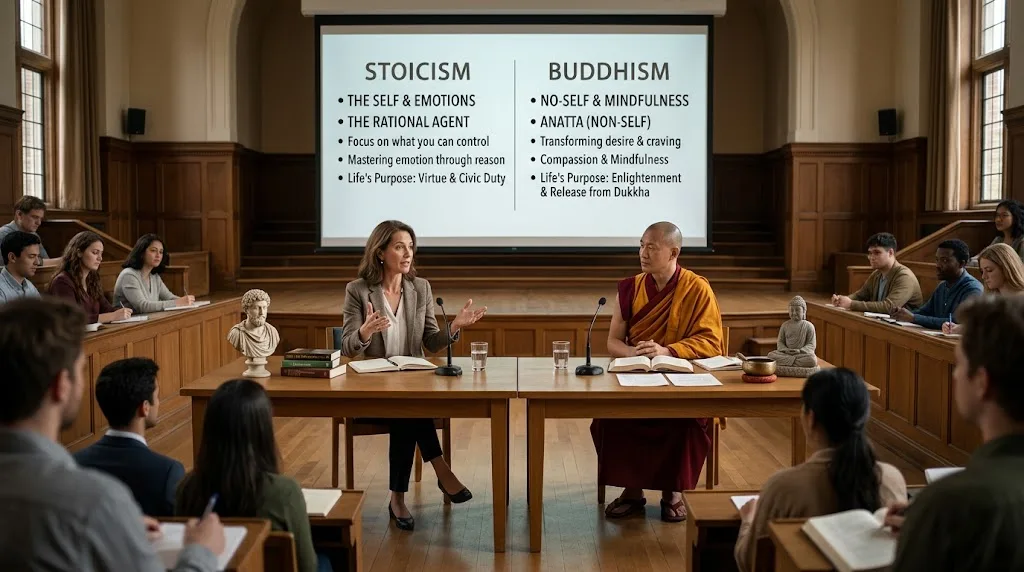
The most meaningful differences between Stoicism and Buddhism concern their underlying accounts of human nature, the good life, and liberation. It's easy to make both traditions sound identical when focusing only on mindfulness, calmness, or acceptance. A closer comparison shows that they use some similar practices within different philosophical frameworks.
The Self: Stoic Moral Agency vs Buddhist Non-Self
Stoicism emphasizes rational agency and moral responsibility. You should examine your impressions, make reasoned judgments, and take responsibility for how you act. Stoic thinkers also situated human beings within a larger natural and social order.
Buddhism, by contrast, teaches non-self (Anatta): the idea that experience doesn't contain a permanent, independent self of the kind people commonly assume exists. This doesn't mean that Buddhism denies ordinary personal existence or that actions have no consequences. It challenges the idea that the person can be understood as an unchanging essence independent of the changing processes that make up experience.
- The practical implications differ.
- A Stoic might respond to criticism by asking, "What does a wise and just person do in this situation?"
A Buddhist might also examine the judgment but investigate the sense of self being threatened: "What am I defending, and why am I treating this opinion as a complete definition of who I am?" Both approaches can loosen the grip of defensiveness, but they do so through different philosophical ideas.
Virtue and Liberation: Different Philosophical Destinations
For Stoicism, virtue is the central human good. Wisdom, courage, justice, and temperance help a person live in accordance with reason and nature. External achievements can be worth pursuing, but they don't replace moral character. Buddhism places liberation from suffering at the center of its path. Ethical behavior, meditation, and wisdom work together to address craving, ignorance, and the conditions that sustain dissatisfaction.
These goals shouldn't be collapsed into a single idea of "being peaceful."
Stoic can seek a successful career, raise a family, participate in public life, and accept that outcomes are uncertain while treating virtue as the foundation of a good life.
A Buddhist may engage in these same activities while understanding practice in relation to craving, impermanence, non-self, and liberation. The meaning of liberation and the practices associated with it vary across Buddhist traditions. The difference matters because Stoicism asks what it means to live well as a rational and social being, while Buddhism offers a path aimed at transforming the roots of suffering.
Emotions: Stoic Judgment and Buddhist Mindful Awareness
Popular descriptions sometimes portray Stoicism as suppressing feelings and Buddhism as accepting every feeling without question. Both descriptions are incomplete.
Classical Stoicism treats destructive passions as connected to mistaken judgments and excessive impulses. The goal isn't simply to hide emotion but to develop sound judgment so that fear, anger, and desire don't control one's decisions. Stoics also recognized involuntary reactions that can arise before a considered judgment. Buddhist mindfulness develops awareness of feelings and mental states. Rather than automatically feeding anger or craving, practitioners learn to observe these experiences and understand their conditions.
For example, when you feel jealous of a friend's success, a Stoic exercise might examine the belief that another person's achievement diminishes your worth. A Buddhist exercise might observe the jealousy, notice the craving for status, and investigate the attachment behind it. Both can support emotional regulation, but neither requires pretending that painful feelings never arise.
Nature, the Cosmos, and Religious or Metaphysical Beliefs
Another major difference lies in each tradition's understanding of reality. Ancient Stoicism included a developed account of the cosmos, often described through Logos: a rational principle that orders nature. Living well meant aligning human reason and conduct with this natural order.
Buddhism developed a different set of teachings about conditioned existence, karma, rebirth, and liberation. These teachings vary in interpretation across Buddhist schools, but they aren't simply Buddhist versions of Stoic cosmology. This distinction is particularly important when comparing modern secular interpretations of either tradition with their historical forms. Contemporary readers may adopt Stoic exercises without accepting ancient Stoic physics, or practice mindfulness without embracing every Buddhist religious commitment. Such adaptations can be useful, but they shouldn't be confused with the complete historical traditions.
Stoicism vs Buddhism: Side-by-Side Comparison Table
| Feature | Stoicism | Buddhism |
| Historical origins | Ancient Greece, later developed in Rome | Ancient India |
| Central concern | Virtue and rational living | Understanding suffering and attaining liberation |
| Main ethical framework | Four Stoic virtues | Ethical conduct within the Noble Eightfold Path and related teachings |
| Suffering | Mistaken judgments and destructive passions can contribute to distress | Craving, ignorance, and conditioned existence are central to the problem |
| View of the self | Emphasizes rational agency and moral responsibility | Teaches non-self rather than a permanent, independent self |
| Approach to emotions | Examine judgments and develop rational responses | Observe mental states and work with craving and aversion |
| Relationship to change | Reflect on mortality, nature, and the instability of externals | Understand impermanence as a characteristic of conditioned phenomena |
| Practical exercises | Stoic reflection, examination of impressions, ethical self-review | Meditation, mindfulness, concentration, and insight |
| Ethical emphasis | Wisdom, courage, justice, and temperance | Wisdom, ethical conduct, compassion, and mental discipline |
| Ultimate aim | Virtuous human flourishing | Liberation from suffering and its underlying causes |
This table offers a broad comparison. Both Stoicism and Buddhism contain diverse interpretations and practices, and their differences extend beyond what a short summary can capture.
Stoic Dichotomy of Control vs Buddhist Non-Attachment
The Stoic dichotomy of control and Buddhist non-attachment are often treated as interchangeable ideas. Both can help people respond more wisely to uncertainty, but they address different aspects of human experience.
The distinction is useful: Stoicism emphasizes the limits of your agency, while Buddhism examines the craving and attachment that make experiences difficult to release.
Understanding the Stoic Dichotomy of Control
Epictetus opens the Enchiridion by distinguishing what depends on us from what doesn't. In practical terms, Stoicism asks you to separate your own judgments, intentions, and choices from outcomes that you cannot guarantee.
Suppose you're preparing for an important presentation. You can research the subject, rehearse your delivery, and answer questions honestly. You can't control every audience reaction, technical problem, or decision made afterward. The Stoic response isn't to stop caring about the presentation. It's to direct your energy toward preparation and responsible conduct rather than exhausting yourself trying to guarantee approval. The distinction also requires care. You can influence some external events without fully controlling them. Your health, relationships, and career may be affected by your actions, but they also depend on circumstances outside your power.
A useful Stoic question is: What is the best action available to me, given the circumstances I actually face?
Understanding Buddhist Non-Attachment
Buddhist non-attachment concerns the way people cling to experiences, possessions, identities, expectations, and outcomes. Attachment in this context doesn't mean caring about nothing. You can love someone, work toward a goal, or value a friendship without insisting that it must remain exactly as you want it to be.
Imagine that you want a promotion. You can work diligently, develop your skills, and appreciate the opportunity. But if your identity depends entirely on receiving the promotion, a disappointing result may feel like a judgment on your entire life. Buddhist practice encourages you to notice that craving for a particular outcome and investigate how it shapes your experience. You can pursue the goal while recognizing uncertainty and remaining open to change.
Non-attachment isn't emotional coldness. In many Buddhist traditions, letting go of possessive attachment goes hand in hand with compassion and care for others.
How the Two Ideas Differ in Everyday Life
Consider a difficult conversation with a family member.
A Stoic might ask, "Can I speak honestly, listen carefully, and respond justly even if the other person disagrees?"
A Buddhist might ask, "Can I notice my anger, the urge to be right, and my attachment to a particular response without allowing them to control the conversation?"
The first emphasizes responsible action within the limits of your influence. The second brings attention to the internal grasping and aversion that can sustain distress.
Together, they offer a useful sequence:
- Identify what you can reasonably influence.
- Notice the expectations and attachments shaping your reaction.
- Choose an ethical response.
- Accept that the outcome may differ from what you hoped for.
This is Stoic acceptance and Buddhist non-attachment in practical terms: act responsibly, care about what matters, and recognize that caring doesn't give you complete control.
““He is a wise man who does not grieve for the things which he has not, but rejoices for those which he has.””
— Epictetus
Note on context: The Stoic dichotomy of control encourages people to focus on their judgments and actions rather than external outcomes. Buddhist non-attachment encourages letting go of excessive craving and clinging to things that inevitably change. Both approaches help people respond to uncertainty with greater balance, though they differ in their philosophical foundations.
Key Takeaway: Focus on what you can influence, appreciate what you have, and avoid tying your peace of mind to outcomes or possessions.
- Identify what is within your control before reacting to a situation.
Stoic Philosophy and Buddhist Philosophy: Virtue, Wisdom, and Ethical Living

A philosophy becomes meaningful when it influences how you treat people and make decisions. Both traditions connect personal development with ethical behavior, although their moral frameworks differ. Stoicism treats virtue as the central good. Buddhism integrates ethical conduct with mental cultivation and wisdom on the path toward liberation.
The Four Stoic Virtues in Daily Practice
The four Stoic virtues provide a practical framework for everyday decisions.
Wisdom means examining facts, identifying assumptions, and choosing an appropriate response. If you're considering a major purchase, wisdom means evaluating your needs and finances instead of buying something simply to impress others.
Courage means doing what is right despite discomfort. It might involve admitting a mistake at work, defending someone being treated unfairly, or having an honest conversation you've been avoiding.
Justice means treating people fairly and recognizing your responsibilities to others. It includes honesty, respect, and a willingness to consider how your decisions affect the wider community.
Temperance means exercising moderation and self-discipline. It can help you manage spending, avoid impulsive reactions, and maintain reasonable boundaries around work and leisure.
These virtues aren't four unrelated personality traits. They work together. Courage without wisdom can become recklessness, while self-discipline without justice can become selfish rigidity. The Stoic aim is to develop a consistent character that makes good decisions across different situations.
The Noble Eightfold Path and Buddhist Ethical Living
The Noble Eightfold Path provides a broader framework for Buddhist practice. Its eight factors are commonly grouped into three areas: wisdom, ethical conduct, and mental discipline.
| Area | Factors of the path | Practical emphasis |
| Wisdom | Right view and right intention | Understanding experience and developing wholesome intentions |
| Ethical conduct | Right speech, right action, and right livelihood | Communicating responsibly, acting ethically, and earning a living appropriately |
| Mental discipline | Right effort, right mindfulness, and right concentration | Cultivating beneficial mental states, awareness, and focused attention |
The word "right" in this context refers to what is appropriate within the Buddhist path, not merely what is convenient or socially approved.
For example, right speech involves more than avoiding obvious lies. It encourages careful attention to how and why you communicate. Before criticizing a coworker, you might consider whether your words are accurate, necessary, and intended to help resolve the problem.
Similarly, right effort involves working with mental habits rather than assuming that awareness alone will change them. Mindfulness and concentration support this process, while wisdom provides a broader understanding of experience. The Eightfold Path isn't simply a checklist for becoming more productive. It's an integrated path of ethical, mental, and contemplative development.
Where Stoic Virtue Ethics and Buddhist Ethics Overlap
Both traditions encourage people to move beyond impulsive self-interest.
Stoicism asks whether your choices reflect wisdom and justice. Buddhist ethics asks whether your intentions and actions fit the path of practice and reduce harmful conduct. They also emphasize repeated effort. Understanding justice doesn't automatically make someone fair, just as reading about mindfulness doesn't automatically create sustained awareness. Both require practice in real situations.
Consider an employee who discovers an error that could make the team look bad. A Stoic approach emphasizes honesty, courage, and responsibility. A Buddhist approach may emphasize right intention, right speech, and the consequences of acting from fear or self-protection. The resulting action may be similar: acknowledge the error and help correct it. The philosophical reasoning behind that action, however, isn't identical.
Applying Both Traditions to Real Ethical Dilemmas
Imagine a manager asks you to take credit for work that a colleague completed.
A Stoic response would examine what justice and courage require. Protecting your reputation at another person's expense would conflict with those virtues.
A Buddhist response could examine the intention behind accepting the credit, the harm caused by dishonesty, and the role of craving for status or approval. Right speech and right action would be relevant to the decision.
Both approaches encourage you to look beyond immediate personal advantage. Neither suggests that ethical decisions are always easy or that one short rule will resolve every conflict.
The practical takeaway is simple: use philosophical reflection to guide what you do, not just how you feel.
Stoicism and Buddhist Mindfulness: Comparing Meditation and Stoic Practices
Stoicism and Buddhism both include exercises designed to train attention and improve conduct. However, Buddhist meditation has a more developed and varied role in formal contemplative practice, while the surviving Stoic writings emphasize exercises such as reflection, examining impressions, and reviewing one's actions. Understanding the difference helps you choose practices that fit your goals without assuming that every exercise belongs equally to both traditions.
Buddhist Meditation and Mindfulness Practices
Buddhist meditation includes a wide range of practices. Some develop concentration, others cultivate mindfulness, and others emphasize insight into the nature of experience. Methods vary across traditions.
A simple mindfulness-of-breathing exercise can be a useful starting point:
- Sit comfortably and allow your breathing to remain natural.
- Notice the physical sensations of breathing.
- When attention wanders, recognize that it has wandered.
- Gently return attention to the breath.
- Observe thoughts and feelings without immediately following every one.
The goal isn't to eliminate thoughts or force yourself into a perfectly calm state. You're practicing awareness of what happens and learning to return attention when it wanders. Vipassana meditation is associated with insight into experience and is practiced in different forms across Buddhist traditions. It shouldn't be treated as a single, universally identical technique.
Over time, meditation can form part of a wider Buddhist practice involving ethical conduct, wisdom, and a deeper investigation of craving and impermanence.
Stoic Reflection and Mental Training
Stoic exercises often focus on examining judgments, preparing for challenges, and evaluating whether daily behavior reflects virtue.
Three useful practices include:
Morning intention-setting:
Before beginning the day, consider the challenges you may face. You might encounter delays, criticism, or people who disagree with you. Decide how you want to respond rather than assuming the day will unfold exactly as planned.
Examining impressions:
When something upsets you, pause before accepting your first interpretation. Ask what you know, what you're assuming, and what a reasonable response would look like.
Evening reflection:
Review your actions without turning the exercise into self-punishment. Where did you act wisely? Where did you respond impulsively? What could you do differently next time?
Another Stoic exercise is negative visualization, which involves reflecting on possible losses or difficulties. Practiced thoughtfully, it can help you appreciate what you have and prepare for uncertainty. It shouldn't become an exercise in constant worry or an attempt to predict every possible disaster. Marcus Aurelius's Meditations offers examples of Stoic self-examination, while Epictetus's teachings emphasize examining impressions and directing attention toward one's choices.
What Stoic and Buddhist Practices Have in Common
Both traditions require regular effort. Neither treats insight as something achieved simply by reading a book or memorizing an inspiring quotation. They also encourage a pause between an experience and a response. That pause can make it easier to notice a familiar pattern before acting on it.
The difference lies partly in the purpose and method of the exercise. Buddhist meditation may train sustained attention or develop insight into impermanence and non-self. Stoic reflection commonly examines judgments and asks how to act in accordance with virtue. You can use both approaches without treating them as the same technique.
A Simple Combined Practice for Beginners
The following routine combines selected exercises from both traditions. It's a modern practical adaptation, not a standardized ancient practice shared by all Stoic and Buddhist schools.
- 1. Practice mindful breathing
2–3 minutes
Notice your breathing and gently return your attention whenever it wanders.
- 2. Observe your reactions
1 minute
Notice your current thoughts, feelings, and impulses without immediately acting on them.
- 3. Identify what you can influence
1 minute
Separate your available choices from outcomes you cannot guarantee.
- 4. Choose a virtuous response
1 minute
Ask what wisdom, courage, justice, or temperance calls for in your next action.
- 5. Reflect at the end of the day
2–3 minutes
Review one difficult reaction, one constructive action, and one lesson for tomorrow.
The routine takes roughly seven to nine minutes, depending on how long you spend reflecting. Keep it simple at first. Consistency is more useful than building an elaborate routine that you abandon after a few days.
““You have power over your mind—not outside events. Realize this, and you will find strength.””
— Marcus Aurelius
Note on context: Stoic practices and Buddhist mindfulness both encourage awareness of thoughts, emotions, and reactions. Stoics use reflective exercises, such as examining judgments and reviewing their actions, to develop wisdom and virtue. Buddhist mindfulness meditation trains attention to the present moment and helps practitioners observe thoughts, feelings, and sensations without excessive attachment. Both approaches encourage a more deliberate response to life's challenges, although their goals and philosophical foundations differ.
Key Takeaway: Stoic reflection emphasizes examining judgments and acting virtuously, while Buddhist mindfulness emphasizes present-moment awareness and understanding mental experiences. Both practices can help people become more self-aware and less reactive.
- Practise daily reflection: Review your choices and identify what you could improve.
Marcus Aurelius and Buddhism: Did Stoic and Buddhist Thinkers Influence Each Other?
Readers often notice similarities between Marcus Aurelius's reflections and Buddhist teachings about change, suffering, and the mind. These parallels are worth exploring, but they don't establish that the two traditions directly influenced each other. Historical evidence matters when moving from philosophical comparison to claims about who learned from whom.
Marcus Aurelius and the Historical Context of Stoicism
Marcus Aurelius (121–180 CE) was a Roman emperor and a prominent Stoic thinker. His Meditations contains personal philosophical reflections on character, responsibility, mortality, and the need to examine one's judgments. His writings emphasize the importance of directing attention toward one's own conduct rather than becoming consumed by reputation or circumstances. He also reflects on the brevity of life and the place of individuals within a larger natural order. His work remains useful for comparison with Buddhist thought because both traditions ask readers to examine their responses to change and adversity. That usefulness doesn't make Meditations a Buddhist text.
Gautama Buddha and the Origins of Buddhist Teachings
Gautama Buddha's teachings developed in ancient India centuries before Marcus Aurelius lived. The Buddhist path centers on understanding suffering and its causes, cultivating ethical conduct and mental discipline, and developing wisdom.
The Four Noble Truths and the Noble Eightfold Path provide a foundation for this approach. Buddhist teachings also examine impermanence and non-self, which distinguish Buddhist philosophy from Stoicism in important ways. These teachings developed across different Buddhist traditions over time. It's therefore more accurate to speak of Buddhist philosophies and practices than to assume every Buddhist school holds precisely the same interpretation.
Did Stoicism and Buddhism Directly Influence Each Other?
The Greek-speaking and Indian worlds weren't completely isolated from one another in antiquity. Trade, travel, and political contact created opportunities for cultural exchange across parts of Asia.
However, the existence of contact doesn't prove that one particular philosopher borrowed ideas from another tradition.
There is no well-established evidence that Marcus Aurelius studied Buddhist scriptures or that the historical Buddha directly influenced the founding of Stoicism. Similar ideas about discipline, suffering, or the instability of life aren't sufficient proof of transmission. Stoicism emerged as a Greek philosophical school associated with Zeno of Citium around 300 BCE. Buddhism developed from the teachings of Gautama Buddha in ancient India. Their histories should be studied on their own terms before drawing comparisons.
Why the Similarities Matter Even Without Proven Direct Influence
Two traditions can address similar human problems without sharing a direct historical origin. People across cultures experience grief, frustration, uncertainty, conflict, and fear of death. Philosophical traditions may develop overlapping practices because they examine some of the same challenges, even when their explanations differ.
For example, Stoic reflection on mortality and Buddhist contemplation of impermanence can both encourage people to value the present. Yet Stoic reflection is embedded in a philosophy of virtue and nature, while Buddhist impermanence is part of a broader account of conditioned existence and liberation. The most productive comparison asks what each tradition actually teaches, why it teaches it, and how its practices work within the wider philosophy.
Stoicism and the Four Noble Truths: Two Approaches to Understanding Suffering

The Four Noble Truths provide a central framework for Buddhist thought. Comparing them with Stoic principles helps explain how both traditions address suffering without assuming that they offer the same diagnosis or solution.
The Four Noble Truths Explained
The Four Noble Truths can be understood as a framework for recognizing a problem, examining its causes, understanding the possibility of its cessation, and following a path of practice.
1. The truth of suffering (Dukkha).
Human life includes pain, loss, dissatisfaction, and the instability of experiences that people often want to preserve. This teaching doesn't mean that every moment is consciously miserable.
2. The truth of the origin of suffering.
Craving plays a central role in sustaining suffering. People cling to pleasurable experiences, resist unwanted experiences, and seek certainty from things that continually change.
- 3. The truth of the cessation of suffering.
Buddhist teachings hold that suffering can cease through the relinquishment of craving and the transformation of ignorance.
4. The truth of the path leading to cessation.
The Noble Eightfold Path provides the framework for ethical conduct, mental cultivation, and wisdom through which this transformation is pursued.
These truths aren't simply four motivational statements. They form an integrated framework for Buddhist understanding and practice.
How Stoicism Approaches the Same Human Problems
Stoicism doesn't teach the Four Noble Truths under a different name. Instead, it offers its own explanation of the good life and the obstacles to living it. Stoics examine the judgments people make about external events and the impulses that follow. They argue that wealth, status, and favorable outcomes cannot substitute for virtue.
Imagine that you fail an important exam. You may feel disappointed, and you may face real consequences. Stoic practice asks you to examine the meaning you're assigning to the failure and decide what to do next. You might recognize that your preparation was inadequate, develop a better study plan, and accept that the past result cannot be changed. The experience becomes an opportunity to practice wisdom and perseverance.
A Buddhist approach might also examine disappointment but give greater attention to the craving for success, attachment to identity, and the changing nature of the experience. Both traditions encourage examination, but their explanations of suffering and their ultimate goals remain distinct.
For a deeper understanding of Stoic philosophy, explore our guide to [Stoic Terms: Essential Stoic Philosophy Concepts and Their Meanings], which explains key concepts such as virtue, eudaimonia, logos, and the dichotomy of control.
Comparing Their Practical Lessons
| Question | Buddhist approach | Stoic approach |
| Why am I distressed? | Investigate craving, aversion, ignorance, and the conditions sustaining suffering | Examine judgments and assumptions about what is good, bad, or necessary |
| What should I observe? | The changing nature of experience and the reactions it produces | Impressions, judgments, intentions, and available choices |
| What should I practice? | Ethical conduct, meditation, mindfulness, and wisdom | Virtue, rational reflection, and responsible action |
| What is the broader goal? | Liberation from suffering and its underlying causes | Virtuous living and human flourishing |
The comparison is useful because it shows how two traditions can recommend thoughtful responses to similar situations without offering identical accounts of human nature.
Buddhist Philosophy of No-Self vs the Stoic View of Personal Identity
Personal identity is one of the deeper differences between Stoicism and Buddhism. Both encourage people to examine habitual assumptions, but Buddhism's teaching of non-self is more radical than the familiar advice to stop taking things personally.
What Does Buddhism Mean by Non-Self (Anatta)?
The Buddhist teaching of Anatta challenges the assumption that a permanent, independent self exists behind changing bodily and mental experiences.
Thoughts change. Feelings come and go. Physical characteristics, social roles, memories, and beliefs also change. Buddhist analysis asks whether any of these can reasonably be treated as a permanent, independent essence that defines the person. This teaching doesn't mean that people cannot use the word "I," maintain relationships, or take responsibility for their actions. It challenges a particular understanding of what a self is and how attachment to that idea contributes to suffering.
For example, someone might think, "I'm a failure because I lost my job." That conclusion treats a temporary event as a fixed identity. Buddhist reflection can help reveal the changing conditions behind the experience and question the attachment to a rigid self-image.
How Stoicism Understands Agency and the Person
Stoic philosophy places strong emphasis on rational judgment, moral agency, and responsibility for conduct.
Rather than treating every external event as a verdict on your character, Stoicism asks whether your actions reflect wisdom and justice. You may make mistakes, but you can examine them and work toward better decisions. A Stoic doesn't need to believe that personal identity is perfectly fixed. The key point is that the capacity to reason, choose, and act virtuously is central to Stoic ethics.
This differs from Buddhist non-self, which questions the notion of a permanent, independent self more directly.
What These Views Mean for Everyday Life
Imagine that someone criticizes your performance at work. A Stoic response might be to evaluate the criticism fairly, acknowledge any genuine mistakes, and correct them without allowing another person's opinion to determine your moral worth.
A Buddhist response might also examine the criticism but investigate the attachment to reputation and the sense of a self that feels threatened. The practical responses may overlap: listen carefully, avoid defensiveness, and make improvements where needed. But the underlying reasoning differs.
Neither approach encourages abandoning accountability. You can question rigid ideas about identity while still acknowledging your responsibilities and learning from mistakes.
““All conditioned things are impermanent.””
— The Buddha, Dhammapada, Chapter 20, Verse 277
Note on context: Buddhist philosophy teaches anattā (not-self), the view that no permanent, independent self can be found within the changing physical and mental processes that make up a person. Stoicism, by contrast, emphasizes the rational and moral self: a person develops character through reason, judgment, and virtuous action. Both traditions recognize that human experiences and circumstances change, but they approach personal identity differently. Buddhist practice investigates attachment to the idea of a fixed self, while Stoic practice focuses on cultivating a wise and virtuous character.
Key Takeaway: Buddhism challenges the idea of a permanent, independent self, while Stoicism emphasizes developing a rational, virtuous character. Both encourage self-examination and a wiser relationship with changing experiences, but their accounts of personal identity are distinct.
- Recognize that thoughts, emotions, and physical experiences continually shift.
Stoicism and Emotional Control: How Both Traditions Help Manage Difficult Feelings
Stoicism and Buddhism offer ways to work with difficult emotions, but neither should be reduced to a technique for appearing calm. The goal is to understand your reactions, respond more wisely, and avoid letting temporary feelings dictate harmful actions.
Stoic Emotional Regulation Through Examining Judgments
Stoic philosophy connects destructive passions with judgments about what is good, bad, or necessary. If you assume that every criticism is a personal disaster, you may respond with anger or defensiveness. Examining that assumption can help you choose a more constructive response. This doesn't mean you can instantly switch off sadness, fear, or anger. An initial emotional reaction may arise before you have time to evaluate it. Stoic practice focuses on how you interpret that reaction and what you decide to do next.
Try asking yourself three questions when a difficult emotion appears:
- What actually happened, and what am I assuming about it?
- Is my response proportionate to the situation?
- What action would reflect wisdom, courage, justice, and temperance?
For example, if a coworker takes credit for your contribution, you don't need to pretend that the situation is acceptable. You can document your work, address the issue professionally, and seek appropriate support without allowing anger to determine every decision. The aim is reasoned emotional regulation, not emotional numbness.
Buddhist Mindfulness, Acceptance, and Compassion
Buddhist mindfulness offers another way to approach difficult feelings. Instead of immediately arguing with an emotion or acting on it, you practice recognizing it as an experience that arises under particular conditions.
Suppose you're anxious about an upcoming presentation. You might notice a racing heartbeat, thoughts about embarrassment, and an urge to avoid the event. Mindfulness invites you to observe these sensations and thoughts without automatically treating them as commands. You can acknowledge anxiety while still preparing for the presentation.
Buddhist practice also emphasizes compassion in many traditions. Rather than criticizing yourself for feeling afraid, you can recognize that fear is a common human experience and respond with patience. Acceptance doesn't mean approving of harmful behavior, ignoring a genuine problem, or refusing to take action. It means recognizing what is happening clearly enough to respond appropriately.
Applying Both Approaches to Anger, Anxiety, and Frustration
| Difficult feeling | Stoic practice | Buddhist practice |
| Anger | Examine your judgments and choose a just response | Observe anger and the urge to retaliate without automatically following them |
| Anxiety | Separate practical preparation from attempts to guarantee an outcome | Notice fearful thoughts and sensations while recognizing uncertainty |
| Frustration | Question unrealistic expectations and identify the next useful action | Observe aversion and the demand that circumstances must be different |
| Grief | Acknowledge the loss while focusing on how to respond with virtue | Recognize the pain of loss and the impermanence of relationships and experiences |
| Jealousy | Examine beliefs about status, comparison, and personal worth | Notice craving, comparison, and attachment to a desired identity |
These are complementary illustrations, not exclusive rules. A Stoic can practice paying attention to feelings, and a Buddhist can reason carefully about a difficult situation. The traditions also shouldn't be treated as guaranteed solutions to every emotional problem. Their practices may support personal reflection and well-being, but persistent or severe distress may require help from a qualified mental health professional.
Can You Practise Stoicism and Buddhism Together? Practical Lessons for Daily Life
Yes. You can practice Stoicism and Buddhism together, particularly when you approach them as distinct traditions that offer useful exercises rather than assuming they share every belief. Stoic reflection can help you clarify your responsibilities and examine judgments. Buddhist mindfulness can help you observe craving, aversion, and changing experiences. Together, these practices can encourage more thoughtful decisions and a less reactive relationship with uncertainty.
The key is to understand what each exercise is intended to teach.
Why Stoicism and Buddhism Can Complement Each Other
Imagine that you don't receive a promotion you worked hard to earn.
A Stoic approach can help you distinguish your effort and conduct from the final decision. You can review your performance, seek feedback, and decide what to improve without treating the outcome as proof that your life has gone wrong. A Buddhist approach can help you observe disappointment, the desire for recognition, and the belief that professional success must determine your worth. You can acknowledge these reactions while recognizing that circumstances and feelings change.
Both approaches leave room for action. You might ask your manager about future opportunities, improve your qualifications, or look for another position. The benefit comes from combining two kinds of reflection: What can I do wisely? and What am I clinging to that is making this experience harder?
However, the two traditions don't resolve every philosophical question in the same way. If you're studying them deeply, keep their different views of virtue, non-self, nature, and liberation in mind.
A Daily Stoic and Buddhist Routine
You don't need to redesign your entire life to begin practicing these ideas. Start with a few minutes in the morning, short pauses during the day, and a brief evening review.
- Morning:
Set an intention
3–5 minutes
Identify a likely challenge and consider how you want to respond. Choose one Stoic virtue to emphasize, such as courage during a difficult conversation or temperance when facing an impulse.
- During the day:
Pause and observe
1–2 minutes as needed
Notice your breathing, thoughts, and emotional reactions. Before responding to a stressful message or disagreement, separate what happened from the story you're telling yourself about it.
- Evening:
Review your choices
3–5 minutes
Reflect on where you acted well, where an attachment or judgment influenced you, and what you could try differently tomorrow. Focus on learning rather than blaming yourself.
This routine is a practical combination inspired by both traditions, not a traditional sequence prescribed by either one. Adapt it to your circumstances and, if you want to follow Buddhism more deeply, learn how the exercises fit within the particular Buddhist tradition you're studying.
A Seven-Day Beginner Plan for Practicing Both Philosophies
Use this one-week plan to turn ideas into small, repeatable actions.
Your weekly practice
0 of 7 completed
- Day 1:
Explore the dichotomy of control
Identify one concern and separate your choices from the outcome you cannot guarantee.
- Day 2:
Practice mindful breathing
Spend five minutes observing your breath and returning attention when it wanders.
- Day 3:
Apply a Stoic virtue
Choose wisdom, courage, justice, or temperance and put it into practice.
- Day 4:
Notice impermanence
Observe one changing experience without demanding that it remain the same.
- Day 5:
Work with frustration
Pause during a difficult moment, notice your reaction, and choose a constructive response.
- Day 6:
Practice compassion and justice
Listen carefully, speak honestly, or take a fair action that helps another person.
- Day 7:
Review and adjust
Identify which exercise was useful and choose a manageable routine for the next week.
Reset weekly plan
Don't worry about doing every exercise perfectly. The aim is to build awareness and consistency, not turn philosophical practice into another source of pressure.
Common Mistakes When Combining Stoicism and Buddhism
Several misunderstandings can make a combined approach less useful.
- Treating Stoicism as emotional suppression: Stoicism asks you to examine judgments and develop virtue, not simply hide every sign of emotion.
- Treating Buddhist non-attachment as indifference: Non-attachment doesn't require you to stop caring about people, relationships, or responsibilities.
- Assuming you control every thought: The Stoic dichotomy of control concerns your agency and choices; it doesn't mean you can prevent every involuntary thought or feeling.
- Equating the traditions: Their practical similarities don't erase differences in metaphysics, personal identity, ethics, and ultimate aims.
- Collecting ideas without practicing them: Reading Marcus Aurelius or learning about mindfulness can be useful, but neither replaces applying the teachings.
- Expecting instant peace: Difficult feelings will still arise. Progress is better approached as ongoing practice than as a guarantee of permanent calm.
Which Philosophy Should You Start With?
The best starting point depends on what you want to explore. Start with Stoicism if you're interested in ethical decision-making, personal responsibility, rational judgment, and responding constructively to outcomes you can't fully control. Epictetus's Enchiridion and Marcus Aurelius's Meditations are useful starting texts.
Explore Buddhism if you're particularly interested in meditation, mindfulness, craving, impermanence, and the nature of the self. An introductory text that explains the Four Noble Truths and Noble Eightfold Path can provide a stronger foundation than studying meditation techniques alone. You don't have to choose one forever. You can begin with a simple Stoic reflection exercise and a short mindfulness practice, then study each tradition more deeply as your interest grows. The important thing is to understand what you're practicing and why.
How to Apply This in Daily Life
- 1Reflect on this Stoic exercise each morning before starting your tasks.
- 2Apply the dichotomy of control when navigating unexpected setbacks or decisions.
- 3Journal your reflections in the evening to reinforce clarity and discipline.
Frequently Asked Questions
Concluding Thoughts
Stoicism and Buddhism share a practical concern with how people respond to suffering, uncertainty, and difficult emotions. Both encourage self-examination, ethical conduct, and deliberate practice instead of leaving every decision to impulse. Their differences are just as important as their similarities. Stoicism places virtue, reason, and moral responsibility at the center of a good life. Buddhism examines craving, impermanence, and non-self as part of a path toward liberation from suffering.
You can draw practical lessons from both without pretending they teach the same philosophy. Use Stoic reflection to examine your judgments and decide what responsible action requires. Use Buddhist mindfulness to observe changing thoughts and feelings and recognize the attachments that may intensify distress. Start small. Spend a few minutes observing your breathing, identify one thing you can influence, and choose one action that reflects wisdom or compassion. Review what you learn and continue practicing.
The goal isn't to eliminate every difficult emotion or control every outcome. It's to develop a more thoughtful, ethical, and flexible response to the life you're actually living.

Hi, I’m Mehrab Khursheed, a professional Content Writer and Digital Marketing Expert with 4 years of experience in the digital industry. I studied at The Islamia University of Bahawalpur. I specialize in creating engaging, actionable content on practical Stoicism, mental resilience, personal growth, and philosophical frameworks for modern life.