
What Is Plato's Apology About?
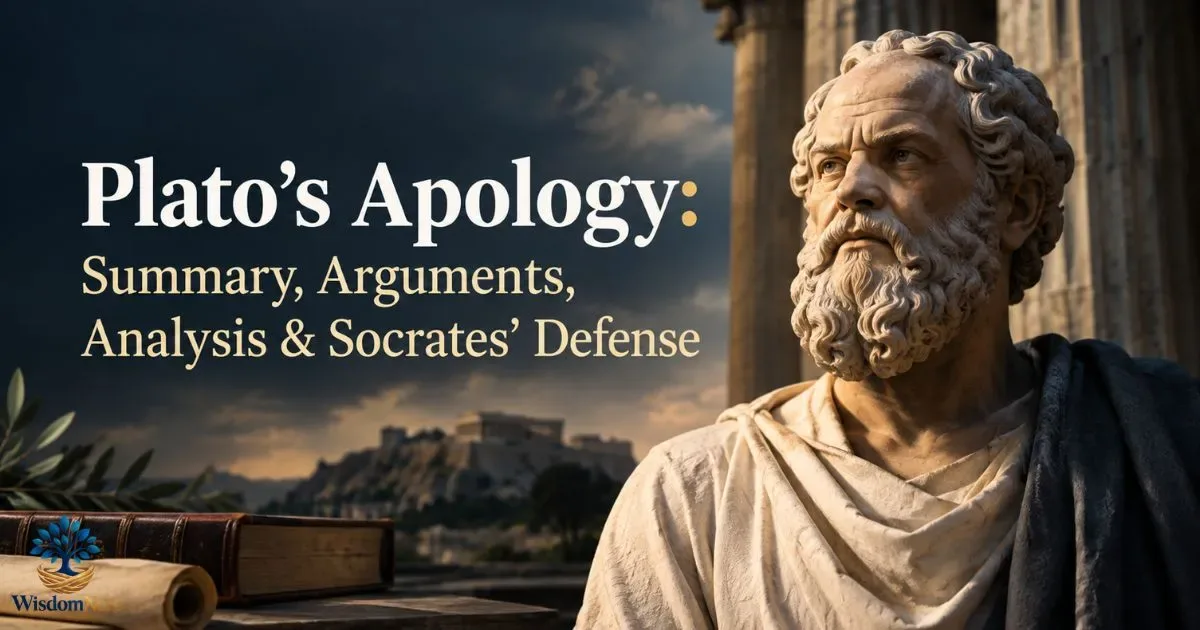
Plato's Apology is a philosophical dialogue presenting Socrates' defense at his trial in Athens. The word “apology” can be misleading to modern readers. Here, it does not mean saying sorry. It comes from the Greek idea of a formal defense or speech made in response to an accusation.
Plato places Socrates at the center of the dialogue, but Plato himself is the author. Socrates wrote no philosophical books of his own, so works such as the Apology are crucial to how later generations have understood him. At the same time, the historical Socrates and Plato's literary Socrates cannot be assumed to be identical in every detail. The dialogue focuses on several connected questions: What makes someone wise? What does it mean to live virtuously? Should a person fear death? Can an individual remain committed to justice when a powerful institution demands something else?
The trial therefore becomes a setting for Socratic philosophy. Socrates is not merely defending his reputation. He is defending the value of philosophical examination itself.
Who Were Socrates and Plato?
Socrates was an Athenian philosopher known primarily through the writings of Plato and other ancient authors. Unlike Plato, he did not leave a written body of philosophical works.
Plato was an Athenian philosopher and writer whose dialogues made Socrates one of the central figures of Western philosophy. Modern scholarship recognizes that Plato's dialogues are literary and philosophical works, so questions about exactly which ideas belong to the historical Socrates remain debated. That distinction matters when reading the Apology. The dialogue can be studied both as evidence about Socrates and as a carefully constructed philosophical text.
When and Where Does the Trial Take Place?
The trial takes place in Athens around 399 BCE, before an Athenian jury. Socrates is prosecuted by Meletus, with Anytus and Lycon also associated with the prosecution. His formal accusations concern corrupting the youth and religious wrongdoing, including not recognizing the city's gods and introducing other divine beings. Plato's text distinguishes these later accusations from the older public reputation that had surrounded Socrates for years.
“The unexamined life is not worth living.”
— Plato, Apology "Socrates’ defense speech at his trial in Athens."
Note on context: The work explores Socrates’ defense against accusations of corrupting the youth and not believing in the city’s gods. Socrates argues that a meaningful life requires questioning beliefs, examining one’s actions, and pursuing wisdom rather than wealth or reputation.
Key Takeaway: Plato’s Apology is ultimately about intellectual honesty, moral courage, self-examination, and the importance of pursuing truth even when doing so carries serious personal consequences.
- Question your assumptions instead of accepting them blindly.
- Examine your choices and beliefs regularly.
- Value wisdom more than wealth or social status.
- Admit what you do not know.
- Stay committed to your principles under pressure.
- Focus on living well rather than simply avoiding criticism.
- Use honest questioning to improve your understanding.
Plato's Apology Summary: Socrates' Trial and Defense
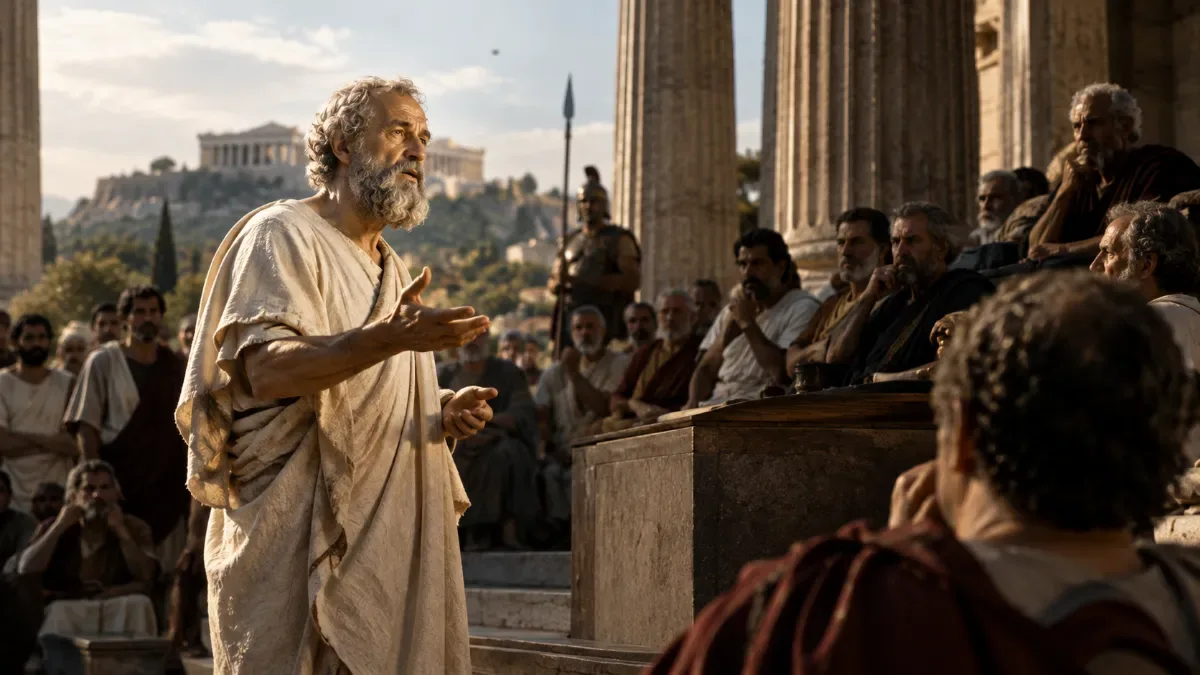
The defense unfolds in several stages. Socrates first addresses the long-standing reputation that has made him unpopular, then turns to the formal charges brought by Meletus. His strategy is unusual. Instead of relying primarily on emotional appeals, he examines the assumptions behind the accusations. His defense becomes an example of the same Socratic questioning that had made him controversial in Athens.
The Old Accusations Against Socrates
Socrates says the older accusations are particularly dangerous because they have influenced Athenians for years. According to the portrayal in the dialogue, people had heard that Socrates investigated things in the heavens and beneath the earth, made weaker arguments appear stronger, and taught such techniques to others.
These accusations blur Socrates with the Sophists and with natural philosophers. Socrates argues that he is not the kind of teacher his opponents imagine. His primary concern is not teaching rhetorical tricks for money but examining claims about wisdom, virtue, and knowledge. This background explains why his trial is not simply about one legal complaint. Socrates is also confronting a public image that has developed over many years.
The Formal Charges Against Socrates
The formal indictment, as Socrates presents it, accuses him of being a wrongdoer who corrupts young people and does not believe in the gods recognized by Athens. It also connects him with introducing different divine beings.
Meletus becomes the main person Socrates questions during this portion of the defense. Anytus and Lycon are also named among his accusers. The charge of corrupting the youth is especially important because Socrates treats it as a claim that should be examined logically rather than answered with emotional pleading.
Socrates' Response to Meletus
Socrates questions Meletus about who improves young people. Meletus' responses lead Socrates toward an apparent contradiction: many people, including the judges and citizens, are presented as capable of improving the youth, while Socrates alone supposedly damages them.
Socrates also challenges the idea that he would intentionally corrupt the people around him. If someone deliberately made the people closest to him worse, Socrates argues, that person would risk being harmed by the consequences. The deeper philosophical point concerns knowledge and responsibility. Socrates treats moral claims as matters that require examination. Simply accusing someone of corruption does not establish what corruption means, how it happens, or whether it is intentional.
The Oracle of Delphi and Socrates' Philosophical Mission
One of the most important parts of the Apology concerns the Oracle of Delphi.
Socrates explains that his friend Chaerephon had asked the oracle whether anyone was wiser than Socrates. Socrates interprets the oracle's response as a challenge because he does not consider himself wise in the ordinary sense. He therefore investigates people regarded as wise, including politicians, poets, and craftsmen. His conclusion is not that they know nothing. Instead, he discovers that some people possess genuine expertise but mistakenly assume that their expertise makes them knowledgeable about matters they have not actually understood.
This leads to the idea of Socratic wisdom: recognizing the limits of one's own knowledge. Socrates describes his advantage as knowing that he does not know what he does not know.
The Verdict and Socrates' Response
After Socrates gives his defense, the jury finds him guilty. The dialogue then moves from the question of guilt to the question of punishment. Socrates does not respond as someone desperate to say whatever is necessary to survive. Instead, he continues defending the philosophical life that brought him before the court.
Socrates' Proposed Penalty
Socrates initially suggests that he should not be punished for his activities because he believes his philosophical work benefits Athens. He eventually discusses a monetary fine, with Plato and others willing to act as sureties for a larger amount. His response is deliberately provocative because he does not accept the premise that encouraging citizens to care about virtue is itself a service deserving punishment.
For Socrates, wealth, reputation, and physical safety rank below the condition of the soul.
Socrates' Final Speech After the Death Sentence
After the jury chooses death, Socrates delivers another speech. His focus shifts from defending himself against the original accusations to explaining why he does not regard death as something a person should automatically fear.
He argues that nobody knows with certainty whether death is an evil. To fear something while claiming knowledge about its nature would itself resemble the kind of ignorance he has spent his life exposing. This does not mean Socrates claims to know that death is good. His point is more restrained: human beings should not pretend to possess knowledge they do not have.
Socrates' Main Arguments in Plato's Apology
The strongest parts of Socrates' defense are not merely legal arguments. They reveal a consistent ethical position about knowledge, virtue, justice, and death.
Socrates' Argument From Ignorance
Socrates' famous wisdom paradox begins with a simple distinction: there is a difference between actually knowing something and believing that you know it. His investigation of supposedly wise people suggests that expertise in one area does not automatically produce wisdom about life as a whole. A skilled poet may create beautiful poetry without being able to explain virtue. A skilled craftsman may understand a craft without understanding morality.
Socrates' pursuit of wisdom therefore begins with intellectual humility. Recognizing ignorance does not mean abandoning knowledge. It means refusing to confuse confidence with understanding.
The Argument About Corrupting the Youth
Socrates challenges Meletus by examining who improves and corrupts young people. He also questions whether corruption would be intentional. The reasoning matters because Socrates does not simply say, “I am a good person, so the accusation is false.” Instead, he asks what would logically follow if the accusation were true.
This approach illustrates the Socratic method: test a claim by examining its definitions, assumptions, and consequences.
The Argument About the Gods
Socrates also challenges the religious accusation. Meletus portrays him as someone who does not believe in the gods of Athens while also accusing him of introducing other divine beings.
Socrates uses questioning to expose tension within the accusation. If he accepts divine or spiritual matters in some sense, the claim that he is simply an atheist becomes difficult to maintain. The exchange is more complicated than a modern debate about whether Socrates was “religious” or “not religious.” The dialogue presents Socrates as someone who believes his philosophical activity is connected to a divine mission while also challenging conventional assumptions about knowledge and piety.
The Argument That One Must Obey Moral Principle
Socrates repeatedly places justice and moral integrity above personal survival.
He recalls an earlier occasion when political authorities ordered him to participate in an unjust action. In the dialogue, Socrates presents his refusal as evidence that he does not simply follow whoever possesses political power. This is crucial to his defense. His position is not that authority is always wrong. Rather, authority does not automatically make an unjust action right.
The Argument Against Fear of Death
Socrates argues that fearing death as though it were certainly the greatest evil assumes knowledge that human beings do not possess. He knows something else with greater confidence: doing wrong is morally bad. So he refuses to allow uncertainty about death to outweigh what he regards as a clear moral principle.
The argument can be summarized simply:
We don't know exactly what death is, but we can still know that deliberate wrongdoing is wrong.
That distinction explains much of Socrates' courage during the trial.
The Examined Life
Near the end of his defense, Socrates makes one of the dialogue's most important claims: the unexamined life is not worth living. He does not mean that everyone should spend every day studying philosophy formally. The broader idea is that a worthwhile human life requires reflection.
For example, someone might pursue money, status, or popularity without ever asking why those things matter. Socrates would encourage that person to examine the assumptions behind those goals.
The examined life is therefore a life of questioning: What do I value? Why do I believe it? Is my behavior consistent with my principles? Am I pursuing what is genuinely good, or merely what appears impressive?
Plato's Apology Analysis: Major Philosophical Themes
The dialogue becomes much more significant when read as an exploration of how a person should live.
Knowledge, Ignorance, and Socratic Wisdom
Knowledge is not simply the possession of facts. Socrates is concerned with whether people understand the limits of their knowledge. That makes Socratic wisdom fundamentally different from intellectual arrogance. The wise person remains willing to question assumptions, investigate evidence, and revise beliefs.
Truth vs. Persuasion
Socrates does not present himself as a conventional courtroom rhetorician. His defense repeatedly returns to examination and reasoning.
That creates a contrast between truth and persuasion. Winning an argument and discovering what is true are not necessarily the same activity. A person can persuade an audience while being mistaken. Conversely, a truthful argument can fail to persuade.
Virtue and the Good Life
Socrates argues that people should care more about the condition of their souls than about wealth, reputation, or physical possessions. He explicitly tells the Athenians to prioritize the perfection of the soul and connects virtue with the good things of life. This is the heart of his moral philosophy. A successful life is not defined merely by comfort or social status. It also depends on the quality of one's character.
Justice and Moral Responsibility
Justice, for Socrates, cannot be reduced to whatever the majority happens to approve. His defense suggests that individuals remain responsible for their actions even when social pressure points in another direction. This makes the Apology an important text for thinking about moral responsibility and conscience.
Socrates’ emphasis on virtue, self-examination, and understanding how we should live also connects with other ancient philosophical traditions. Readers interested in exploring different approaches to wisdom, self-awareness, and ethical living can learn more in our guide to Stoicism and Buddhism, which examines the similarities and differences between these two traditions.
The Role of the Socratic Method
The Socratic method works through questions rather than simply presenting a finished doctrine.
- A simplified example would be:
- Someone claims that courage means never feeling fear.
- Socrates asks whether reckless behavior can also involve fearlessness.
- If reckless behavior can be foolish rather than courageous, the original definition becomes inadequate.
- The discussion must then search for a better definition.
This method turns ordinary assumptions into subjects of examination.
Socrates' Death and the Meaning of the Unexamined Life
Socrates' death is not an accidental ending added to the dialogue. It completes the ethical argument running throughout his defense. He has claimed that virtue matters more than survival. After the verdict, he therefore refuses to abandon that principle simply because the consequences have become personally dangerous.
Why Socrates Refuses to Abandon Philosophy
Socrates says that even if Athens offered him freedom on the condition that he stop philosophizing, he would refuse that condition. He presents philosophical examination as part of his divine mission. For him, philosophy is not merely an academic hobby. It is a way of living responsibly. Socrates' courage comes from ranking moral wrongdoing above physical danger.He compares his position to the behavior expected of someone who remains at a post because he believes it is right to remain there, despite danger.
The example illustrates a broader principle: courage is not necessarily the absence of fear. It can mean refusing to let fear determine what is right.
What Does Socrates Say About Death?
Socrates presents two broad possibilities. Death could be a dreamless absence of awareness, or it could involve some form of continued existence in which the dead encounter others.
He does not claim certainty about either possibility. Instead, he emphasizes the limits of human knowledge. His final attitude is therefore not simply “death is good.” It is closer to this: we should not pretend to know that death is evil when we do not know what death is.
The Meaning of “The Unexamined Life”
The unexamined life is a life lived without serious reflection on one's values, beliefs, and choices.
Imagine someone choosing a career solely because it brings status. If that person never asks whether the work aligns with their values or contributes to a meaningful life, Socrates would likely consider the decision insufficiently examined. The phrase is therefore not a demand for constant self-criticism. It is an invitation to think carefully about how and why we live.
Why Plato's Apology Still Matters Today
The continuing appeal of Plato's Apology comes from questions that remain recognizable even after more than two millennia. Modern students, professionals, citizens, and leaders still face questions about evidence, expertise, reputation, morality, and social pressure. The dialogue provides no simple formula for solving every modern problem, but it offers a powerful framework for examining assumptions.
What Plato's Apology Teaches About Critical Thinking
The Socratic approach encourages people to ask:
What exactly does this claim mean? What evidence supports it? Does the reasoning contradict itself? What assumptions are hidden underneath it?
Those questions are useful in classrooms, workplaces, online discussions, and everyday decision-making.
What It Teaches About Intellectual Humility
Socrates' treatment of ignorance remains relevant because confidence is not the same as knowledge. A person who can say “I don't know” has created room for investigation. That simple admission can be more intellectually productive than defending an unsupported belief.
Socrates’ emphasis on wisdom, virtue, self-examination, and moral responsibility also connects with ideas explored in Stoic philosophy. Understanding concepts such as arete (virtue), logos (reason), and eudaimonia (human flourishing) can help readers explore these philosophical connections further. Read our guide to [Stoic Terms: Essential Stoic Philosophy Concepts and Their Meanings] to learn how these concepts shape Stoic ethics and everyday life.
What It Teaches About Moral Integrity
The dialogue also asks readers to consider what happens when personal interests conflict with principles.
Someone might remain silent about wrongdoing because speaking up could damage a career or reputation. Socrates' example raises the harder question: Is avoiding personal harm always more important than acting justly?
The dialogue does not turn that question into a simple modern rule. Instead, it encourages readers to examine their own reasoning.
Plato's Apology: Key Characters and Concepts at a Glance
| Character/Concept | Role or Meaning |
|---|---|
| Plato | Author of the dialogue |
| Socrates | Defendant and central speaker |
| Meletus | Main accuser questioned by Socrates |
| Anytus | One of Socrates' accusers |
| Lycon | One of Socrates' accusers |
| Oracle of Delphi | Source of the oracle connected with Socrates' philosophical mission |
| Socratic method | Question-based approach to examining claims |
| Virtue | Central concern of Socrates' ethical thinking |
| Piety/Impiety | Important concepts in the religious accusation |
| Examined life | A life involving continual reflection and philosophical inquiry |
How to Apply This in Daily Life
- 1Reflect on this Stoic exercise each morning before starting your tasks.
- 2Apply the dichotomy of control when navigating unexpected setbacks or decisions.
- 3Journal your reflections in the evening to reinforce clarity and discipline.
Frequently Asked Questions
Concluding Thoughts
Plato's Apology is much more than an account of an ancient courtroom trial. It is a sustained examination of what it means to live wisely and morally when reputation, authority, and even personal safety are at stake. Socrates responds to his accusers through questioning. He examines the charges of corruption and impiety, explains the significance of the Oracle of Delphi, defends his philosophical mission, and argues that recognizing one's ignorance is a form of wisdom. Most importantly, he refuses to treat survival as the highest human good.
The dialogue's central lesson lies in the connection between knowledge, virtue, and self-examination. Socrates does not claim to know everything, especially about death. Instead, he insists that people should distinguish what they genuinely know from what they merely assume.
That is why Plato's Apology remains such an influential philosophical text. Its courtroom setting belongs to ancient Athens, but its questions are still recognizable: What do we really know? What makes a life good? When should conscience outweigh convenience? And how should a person respond when pursuing truth carries a serious personal cost?

Hi, I’m Mehrab Khursheed, a professional Content Writer and Digital Marketing Expert with 4 years of experience in the digital industry. I studied at The Islamia University of Bahawalpur. I specialize in creating engaging, actionable content on practical Stoicism, mental resilience, personal growth, and philosophical frameworks for modern life.