


What Is the Answer to the Tree-Falling-in-a-Forest Question?

The simplest answer is that a falling tree produces sound waves even when nobody is present to hear them. However, if you define sound as the conscious experience of hearing, then an unobserved tree produces no experienced sound at that moment. The disagreement comes from two different meanings of the word sound. One refers to a physical phenomenon that can be measured. The other refers to what a listener experiences through hearing.
The Short Scientific Answer
When a tree falls, its trunk may strike the ground, branches may snap, and leaves may rustle. These events cause vibrations that disturb the surrounding air, producing pressure waves that travel outward.
A microphone can detect these acoustic waves without a human being listening to them in real time. The waves can also be recorded and played back later.
Therefore, the absence of a human listener does not prevent the physical production or propagation of sound waves.
The Philosophical Answer Depends on What We Mean by Sound
Imagine two people discussing the question.
- The first says, "Of course the tree makes a sound. Its impact creates vibrations in the air."
- The second responds, "But if nobody hears anything, there is no experience of sound."
Both are addressing different aspects of the same event. The first is talking about physical acoustics, while the second is talking about subjective experience.
The distinction matters because a physical event and the experience associated with it are not identical. Light can reach a camera without anyone viewing the photograph, just as acoustic waves can reach a microphone without anyone listening to the recording. The question is not simply about a falling tree. It asks whether the world exists exactly as we experience it or whether some aspects of experience depend on a perceiving mind.
Does a Tree Make a Sound When It Falls Without Anyone Listening?
Imagine walking through a remote forest early in the morning. A large tree suddenly cracks, falls to the ground, and sends smaller branches snapping around it. No hikers are nearby. No animals are paying attention. No microphone is recording the event.
What happens when a tree falls in an empty forest? The tree still moves, branches still break, and the impact still creates vibrations. The absence of a listener doesn't stop these physical processes. The philosophical question begins when we ask whether those vibrations should be called sound even when nobody experiences them.
Why Human Hearing Is Not Required for Sound Waves
Sound waves are mechanical disturbances that travel through a medium, such as air, water, or wood. When the falling tree hits the ground, it transfers energy to its surroundings and creates pressure variations in the air. Those variations can travel outward until they lose energy or encounter obstacles. A person with functioning hearing might detect them, but the waves don't need a human audience to exist.
A microphone makes the distinction easier to understand. It can register acoustic pressure changes in an empty forest, and a recording can preserve information about those changes for someone to hear later. The recording doesn't prove that anyone heard the original event; it provides evidence that the acoustic event occurred.
A Simple Example: A Bell in an Empty Room
Consider a bell ringing inside a locked room. The bell vibrates, the surrounding air carries pressure waves, and the sound eventually fades. Nobody has to enter the room for those physical processes to take place. Now imagine that someone enters an hour later and finds the bell resting on a table. The person didn't hear it ring, but that doesn't mean it couldn't have rung.
The tree example works in much the same way. If sound means an acoustic event, the answer is yes. If it means a conscious auditory experience, the answer is no one experienced that sound at the time. This distinction resolves much of the apparent paradox without requiring us to deny either the physical event or the importance of perception.
““Esse est percipi.” “To be is to be perceived.””
— George Berkeley
Note on context: Berkeley's philosophy explores the relationship between existence and perception. His famous principle suggests that sensible objects exist as things perceived by a mind. This connects directly to the question of whether a tree makes a sound when nobody is listening.
Key Takeaway: The quote encourages us to question the relationship between reality and our perception of it. Something may exist independently of our awareness, but what we experience and what physically occurs are not necessarily the same.
- Question what you assume to be real.
- Distinguish an event from your experience of that event.
What Is the Difference Between Sound Waves and the Experience of Sound?
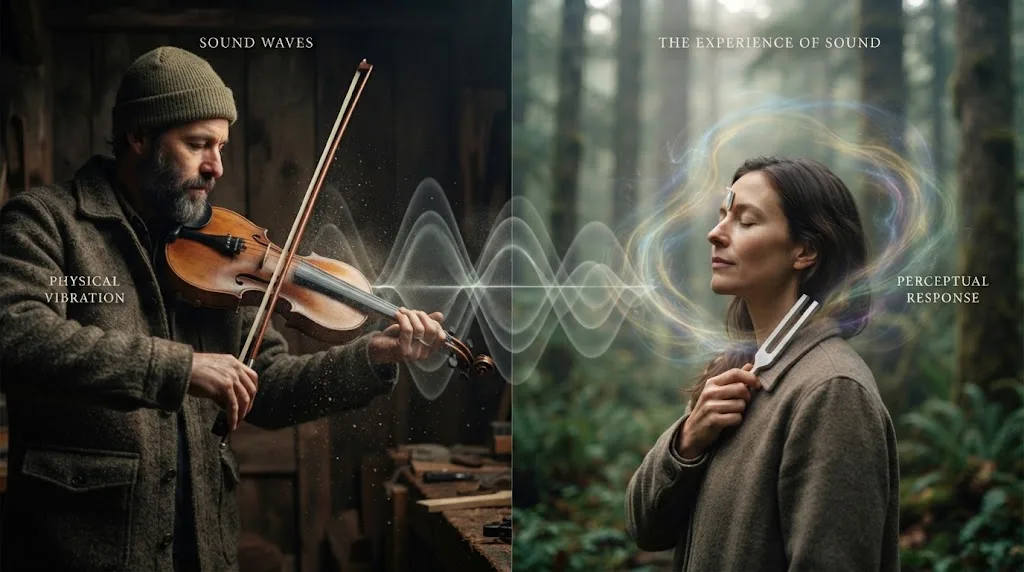
The central issue in the tree-falling question is the difference between a physical process and a sensory experience. Sound waves are physical disturbances, while perceived sound is the experience that arises when an auditory system processes appropriate signals. These concepts are closely connected, but they aren't interchangeable.
How Sound Waves Travel Through Air
Sound generally begins when an object vibrates. The vibration causes nearby particles in a medium to move, producing pressure variations that travel through that medium.
When a tree falls, several sources may contribute to the resulting sound waves: the trunk striking the ground, branches breaking, and leaves or smaller objects moving through the air. Sound can travel through solids, liquids, and gases because these materials can transmit mechanical disturbances. It cannot propagate as an ordinary sound wave through a perfect vacuum because there is no material medium to carry the disturbance.
None of this requires a listener. The physical process takes place whether anyone detects it or not.
How the Human Ear and Brain Turn Vibrations Into Hearing
Hearing involves more than sound waves reaching a person. The outer ear collects sound, and the ear canal directs it toward the eardrum. Vibrations pass through the middle ear to the cochlea in the inner ear, where specialized sensory cells convert mechanical movement into electrical signals. The auditory nervous system then processes those signals.
The result is an auditory experience: a person hears a crack, a rumble, a whistle, or a familiar voice. That experience depends on the physical stimulus as well as the listener's sensory system and brain. Two people may perceive the same acoustic event differently because of differences in hearing, attention, and interpretation.
A microphone can measure pressure changes, but it doesn't follow that the microphone consciously hears anything. Recording a signal and experiencing a sound are different things.
Sound as a Physical Event vs. Sound as a Perception
The following comparison clarifies why people disagree about the tree question.
| Concept | Meaning | Requires a conscious listener? |
| Sound waves | Physical pressure disturbances traveling through a medium | No |
| Hearing | Biological detection and processing of auditory signals | No conscious listener is required for a signal to reach a hearing system, but hearing as a person’s experience involves perception |
| Perceived sound | The subjective experience of hearing something | Yes, if defined as conscious auditory experience |
| Sound recording | A stored representation of an acoustic signal | No |
The distinction also appears in other senses. Light can reach a camera without anyone looking at the resulting image. An object can reflect light even when nobody sees it.
These comparisons don't settle every philosophical question about perception, but they demonstrate why a physical process shouldn't automatically be equated with the experience of that process.
The philosophy of sound asks us to consider whether our ordinary words describe external events, our experiences of those events, or some combination of the two.
How George Berkeley Explained the Relationship Between Mind and Reality
The tree-falling question connects closely to the philosophy of George Berkeley, an Irish philosopher known for arguing that the existence of sensible objects depends on perception. Berkeley challenged the common assumption that material objects exist entirely independently of any mind. His position, often called immaterialism, raises an intriguing question: if a sound is something we hear, what does it mean to say that a sound exists when nobody hears it?
To understand his answer, we need to look at what Berkeley actually believed rather than reduce his philosophy to the claim that nothing exists unless a human sees it.
Who Was George Berkeley?
George Berkeley (1685–1753) was an Irish philosopher and Anglican bishop whose work explored perception, knowledge, and the nature of reality.
In his 1710 work, A Treatise Concerning the Principles of Human Knowledge, Berkeley argued that the sensible qualities we experience, such as colors, sounds, shapes, and textures, exist as ideas perceived by minds. His philosophy challenged the notion that objects must consist of an unknowable material substance existing entirely outside perception.
Berkeley wasn't simply arguing that the world is imaginary. He believed that ordinary objects are real, but he explained their reality through perception rather than through mind-independent material substance.
What Does "To Be Is to Be Perceived" Mean?
Berkeley's famous principle is commonly expressed in Latin as esse est percipi, meaning "to be is to be perceived."
For Berkeley, sensible objects are collections of ideas perceived through the senses. A tree, for example, is experienced through its visible shape, its texture, its sounds, and other sensory qualities.
He questioned what it could mean to claim that these sensible qualities exist entirely apart from any perception. This argument leads directly to the tree question. If nobody hears a falling tree, can we say that its sound exists in the same way as a sound that someone actually hears?
Berkeley would challenge the idea of an independently existing sound considered apart from perception. But his position includes an important qualification: he did not believe that objects disappear whenever human beings stop perceiving them.
Would Berkeley Say an Unheard Tree Exists?
Berkeley addressed this very kind of objection. If a tree remains in a forest when no human is nearby, what keeps it in existence?
His answer involved God, whom he understood as an eternal perceiving mind. Objects don't cease to exist when human beings leave because they remain perceived by God.
This is a crucial part of Berkeley's idealism. It distinguishes his position from the simplistic claim that the world exists only when a person looks at it. Applied to the tree-falling question, Berkeley's view would treat an unheard sound differently from the ordinary scientific account of acoustic waves. He would question the idea of a sound existing as a sensible quality entirely apart from perception, while maintaining that the world is not dependent on human attention alone.
His argument is philosophical rather than a substitute for acoustics. Physics explains the pressure waves created by a falling tree; Berkeley asks what it means for sensible qualities to exist.
Berkeley's Idealism vs. Common-Sense Realism
The difference becomes clearer when we compare Berkeley's approach with the common-sense belief that objects exist independently of human perception.
| Question | Berkeley's idealism | Common-sense realism |
| What is the status of sensible qualities? | They exist as ideas perceived by minds | They are generally understood as features or effects of a mind-independent world |
| Does a tree vanish when nobody sees it? | No; Berkeley appeals to God's continuous perception | No; the tree exists independently of human observation |
| How should we understand an unheard sound? | The existence of sound as a sensible quality is tied to perception | Acoustic events can occur without anyone hearing them |
| What is the central issue? | How perception relates to existence | How a mind-independent world produces our experiences |
The comparison reveals the deeper issue behind the question. People aren't necessarily disagreeing about whether a tree falls or whether vibrations occur. They're disagreeing about how to understand the relationship between mind, matter, and experience.
““The existence of an idea consists in being perceived.””
— George Berkeley
Note on context: Berkeley argued that the things we see, hear, and touch are perceived ideas rather than material objects existing independently of every mind. His philosophy is known as subjective idealism or immaterialism. He also argued that objects continue to exist when humans are not observing them because they are perceived by God's infinite mind.
Key Takeaway: Berkeley's central idea is that perception is essential to understanding the existence of sensible objects. His philosophy challenges the assumption that reality exists entirely independently of the mind.
- Examine how perception shapes your understanding of reality.
- Consider alternative philosophical explanations before reaching a conclusion.
Is the Tree-Falling Question a Paradox or a Philosophical Thought Experiment?
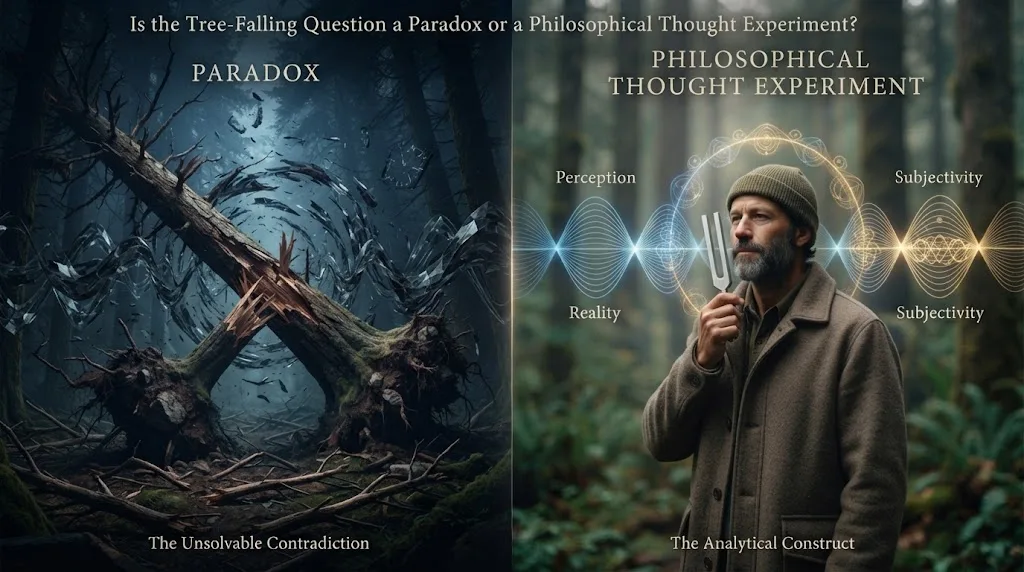
The tree-falling question is best understood as a philosophical thought experiment that exposes an ambiguity in ordinary language. It isn't necessarily a paradox in the strict logical sense, because the apparent contradiction can largely be resolved by distinguishing physical sound from perceived sound. The question encourages us to examine assumptions we usually overlook. We hear a sound and associate it with an event in the outside world. But what exactly do we mean when we say that sound exists?
What Makes the Tree Question Philosophically Interesting?
The question takes a familiar event and removes one element we normally associate with it: the listener.
When someone drops a glass, we hear the crash and immediately connect the sound to the event. We rarely distinguish between the physical vibrations and our experience of hearing them. The thought experiment separates these elements. The tree falls, but nobody hears it. Does the event still produce sound?
This forces us to consider whether sound belongs entirely to the external world, depends partly on a perceiving mind, or involves both physical and experiential elements. Similar questions arise in other areas of philosophy. Does a color exist independently of the way a visual system perceives it? Can something be real even if nobody knows about it? Does the absence of evidence mean that an event never happened?
The tree question doesn't answer all these questions, but it gives us a concrete way to examine them.
Who First Asked If a Tree Falls in a Forest?
The exact origin of the familiar wording is difficult to establish with certainty. It is safer to distinguish the modern formulation from the much older philosophical debate about perception and existence.
George Berkeley's A Treatise Concerning the Principles of Human Knowledge, published in 1710, provides an important historical connection because it directly examines whether sensible objects can exist without being perceived. Berkeley's work is relevant to the question's philosophical background, but that does not establish that he invented the exact tree-falling wording. The broader problem has also been discussed through later thought experiments and popular formulations. Without reliable historical evidence, assigning the exact question to one particular philosopher would be misleading.
Questions about the origins of philosophical ideas also remind us to verify popular attributions carefully. For another example, explore [Did Heraclitus Say “Out of Every 100 Men”? The Original Quote and Its Source] to learn how to distinguish an authentic philosophical fragment from a quote that may have been misattributed.
The useful point is that the underlying issue predates many modern versions of the question: what does it mean for something to exist independently of our experience of it?
The Difference Between a Paradox and a Thought Experiment
A paradox presents an apparent contradiction or a result that conflicts with our expectations. A thought experiment uses an imagined situation to test an idea, principle, or assumption.
The tree question can seem paradoxical because one person says the tree makes a sound while another says it doesn't. But once the two people clarify their definitions, the disagreement becomes easier to understand.
One means that the tree generates acoustic waves. The other means that sound, understood as a conscious experience, requires someone to hear it. Neither position needs to deny that the tree falls. The dispute concerns the meaning of sound and the relationship between physical events and perception.
What the Question Reveals About Language and Definitions
Words often combine several meanings. In everyday conversation, we use sound to describe both an acoustic event and the experience of hearing it.
This usually causes no confusion because the physical event and the experience happen together. The thought experiment separates them, making the ambiguity visible. A useful way to approach similar philosophical questions is to define the key term before trying to answer. Ask whether the discussion concerns a measurable physical process, a conscious experience, or the relationship between the two.
That simple step can resolve disagreements that initially seem much deeper than they are.
Does Sound Exist Without an Observer?
The question of sound without a listener is part of a broader philosophical debate about whether reality exists independently of observation. From the perspective of ordinary acoustics, a falling tree can generate sound waves without anyone detecting them. From the perspective of conscious experience, however, nobody hears a sound unless there is an experiencing subject.
The distinction helps separate a question about physics from a question about the nature of existence.
Objective Reality: Does the World Exist Without Us?
Objective reality generally refers to a reality that exists independently of any particular person's beliefs, feelings, or perceptions.
For example, a mountain doesn't normally stop existing when you turn your back on it. A storm can develop over the ocean even when nobody watches it, and a tree can fall in an uninhabited forest. These examples fit the realist view that the world doesn't depend on human awareness to continue existing.
However, the philosophical question isn't merely whether the tree exists. It concerns the status of its sound. Is sound a property of the physical event, an experience created through hearing, or a term that can refer to both? A realist can argue that the acoustic event occurs independently of the listener while acknowledging that the experience of hearing depends on a hearing subject.
Subjective Experience: Why Hearing Is Personal
The physical world and our experience of it are connected, but experience is not a perfect copy of everything happening around us. A person with normal hearing may perceive a falling branch as a sharp crack. Another person standing farther away may hear only a faint impact. Someone with significant hearing loss may not hear the event at all. The physical event can be the same even though the experiences differ.
This illustrates the relationship between perception and reality. What we experience depends partly on the external stimulus and partly on how our sensory systems process it. It doesn't follow that every experience is purely subjective or that the external event is unreal. It means that the physical event and the experience of that event are different aspects of the situation.
Can Something Exist Without Being Perceived?
Consider a distant star whose light has not yet reached Earth. Or imagine a rock beneath the ocean that no person has ever seen. We commonly regard such things as existing even when nobody perceives them directly. Scientific instruments can also provide evidence about events that humans cannot observe with their unaided senses.
These examples support the distinction between existence and knowledge. Something may exist without being known to us, and something may happen without becoming part of anyone's conscious experience. The tree question challenges us to consider whether sound should be treated in the same way. If sound means a physical acoustic event, its existence doesn't require a listener. If it means an experience of hearing, then it does.
What Is the Difference Between Observation and Awareness?
In everyday language, observation often means looking at or noticing something. In science, however, observation can also mean detecting a signal, recording a measurement, or allowing a measuring instrument to interact with a system. These meanings aren't identical.
A microphone can register sound waves without a person listening to them. A motion sensor can detect movement without anyone watching its display. In both cases, a physical process can be detected or recorded without simultaneous conscious awareness. This distinction becomes especially important when discussing quantum physics. The scientific meaning of measurement doesn't automatically imply that a human mind must witness an event for it to occur.
““I think, therefore I am.””
— René Descartes,
Note on context: Descartes explores certainty, consciousness, and existence. This quote indirectly relates to the observer question by raising the importance of conscious thought, although it does not specifically discuss sound.
How Consciousness Shapes Our Understanding of Reality
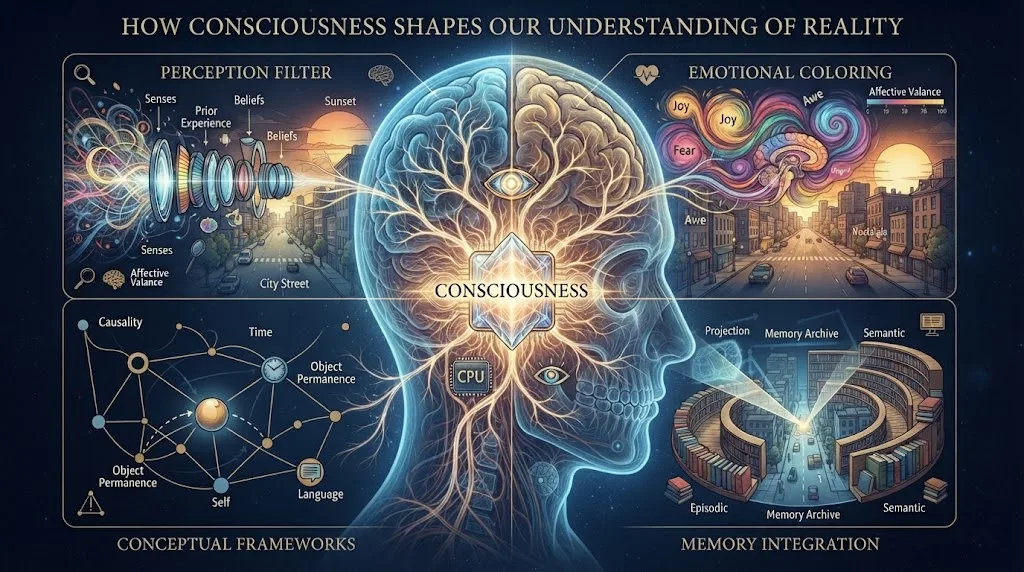
Consciousness is central to the tree-falling question because hearing isn't merely a physical event occurring outside the body. It also involves an experience: the sensation of a sound being heard. The philosophical challenge is understanding how that experience relates to the physical world.
Is Reality Independent of Human Consciousness?
There are different philosophical answers to this question. Realism generally holds that reality exists independently of our beliefs and experiences. On this view, human consciousness allows us to become aware of the world rather than bringing the entire world into existence.
Idealism, in its various forms, gives mind or experience a more fundamental role in explaining reality. Berkeley's version is distinctive because he argues that sensible objects exist as ideas perceived by minds and invokes God's perception to explain their continued existence when humans aren't observing them. These positions disagree about the relationship between mind and world, but the tree question helps make the disagreement concrete.
The relationship between perception, judgment, and reality is also important in Stoic philosophy. In[Was Marcus Aurelius a Good Emperor? Leadership, Stoicism, and His Legacy], explore how Marcus Aurelius applied Stoic principles to leadership and why his philosophical ideals must be evaluated alongside his real-world decisions.
If the tree falls without anyone hearing it, a realist can point to the acoustic event. A philosopher interested in the nature of experience may ask whether the term sound refers to something beyond the physical process that can produce hearing.
How Perception Influences What We Experience
Our senses don't give us unlimited access to everything happening around us. They detect particular kinds of information and operate within particular ranges.
Human hearing, for example, is sensitive to a limited range of sound frequencies. Other animals detect acoustic signals that humans may not hear, while microphones and specialized instruments can measure signals outside ordinary human hearing.
This shows that subjective experience of sound depends partly on the capabilities of the perceiver. The same principle applies to vision. Human beings perceive only part of the electromagnetic spectrum, even though other wavelengths can be measured using instruments. These examples don't prove that consciousness creates the external world. They demonstrate that what we experience is not necessarily identical to everything that physically exists.
The Difference Between What Exists and What We Can Know
Philosophers distinguish between two important questions.
- Ontology asks what exists and what reality is like.
- Epistemology asks what we can know and how we can justify that knowledge.
The tree question involves both.
The ontological question is whether sound exists when nobody hears it. The epistemological question is how we can know what happens in an unobserved forest. Science helps answer the second question through evidence, measurement, and explanations of physical processes. Philosophy examines the assumptions behind concepts such as sound, existence, and perception.
These approaches can work together. Scientific evidence can establish that acoustic waves are produced by a falling tree, while philosophical analysis can clarify whether the existence of those waves is equivalent to the existence of an experienced sound.
Why Human Experience Cannot Answer Every Question About Reality
Personal experience is important, but it has limits.
If nobody hears a tree fall, we cannot point to a person's immediate auditory experience as evidence of that particular sound. We can, however, use our understanding of acoustics, observations of similar events, and measurements from instruments to investigate what happened.
The absence of a direct experience doesn't automatically make an event unknowable. At the same time, measurements don't settle every philosophical question about consciousness. An instrument can record physical information, but whether and how that information relates to subjective experience is a separate question.
The tree thought experiment is valuable because it encourages us to distinguish what happened, what evidence supports our explanation, and what we mean by the words we use to describe it.
What Does Quantum Physics Actually Say About Observation and Reality?
Quantum physics is often brought into discussions about consciousness and the tree-falling question. Some popular explanations suggest that observation creates reality, implying that an event cannot happen in a meaningful sense until a conscious person witnesses it. That conclusion goes beyond what quantum physics establishes.
Quantum measurement is not the same as conscious human observation. Quantum mechanics describes physical systems and how measurements reveal information about them. It does not establish that human consciousness must witness an event for physical processes to occur.
What Is the Observer Effect in Quantum Physics?
In quantum physics, measurement can affect the system being measured. The nature of that interaction depends on the experiment and the physical properties involved. The word observer can be misleading because it sounds as though a conscious person must be watching. In many scientific contexts, observation means a physical interaction that allows information about a system to be obtained.
For example, a detector can register a particle or a photon, and its measurement can be recorded for later analysis. A researcher doesn't have to look at the detector at the precise moment the interaction occurs for the recorded data to exist.
The details of quantum measurement are complex, and different interpretations of quantum mechanics explain the measurement problem in different ways. But the ordinary meaning of a person consciously watching something should not be confused with the technical role of measurement in physics.
Does Quantum Physics Prove That Consciousness Creates Reality?
No. Quantum physics does not establish that human consciousness creates reality or that physical events require a conscious observer to occur.
The confusion often comes from treating three different ideas as though they mean the same thing:
- Measurement:
A physical interaction used to obtain information about a system. - Observation:
A term that can refer to measurement, detection, or conscious awareness, depending on the context. - Consciousness:
The capacity for subjective experience, including the experience of seeing or hearing something.
These concepts can be related, but they aren't interchangeable. Quantum mechanics raises genuine questions about measurement, probabilities, and the outcomes of experiments. It doesn't provide a shortcut to proving that a human mind brings the external world into existence.
Classical Sound vs. Quantum Observation
The falling-tree question can be answered at the level of ordinary acoustics without invoking quantum mechanics. A falling tree generates vibrations and can produce sound waves in the surrounding air. Those waves don't require a conscious person to hear them. The scientific explanation doesn't depend on whether the event is observed by a human being.
Quantum physics becomes relevant only when discussing broader questions about measurement and the interpretation of physical reality. Introducing it as a necessary explanation for a falling tree would complicate a problem that classical physics already addresses. The most useful conclusion is that the observer effect in quantum physics is not evidence that consciousness creates ordinary sounds or that an unheard tree cannot produce acoustic waves.
““No phenomenon is a real phenomenon until it is an observed phenomenon.””
— John Archibald Wheeler.
Note on context: Wheeler's ideas explore the relationship between quantum measurements and physical phenomena. Quantum physics shows that measurement can affect the state of a quantum system, but this does not mean that human consciousness magically creates reality. In physics, an observation generally involves a physical measurement or interaction with a measuring apparatus.
Key Takeaway: Quantum physics challenges some everyday assumptions about observation and measurement. However, the observer effect should not be confused with proof that the universe depends on human consciousness to exist.
- Explore the difference between scientific evidence and philosophical interpretation.
- Recognize that quantum mechanics has multiple interpretations of reality and measurement.
Why This Philosophical Question Still Matters in Everyday Life
The tree-falling question remains useful because it teaches us to separate an event from our experience of it. It also encourages us to examine the assumptions behind familiar words rather than treating every disagreement as a conflict over facts. These lessons apply well beyond philosophy.
What the Tree Question Teaches Us About Assumptions
Imagine two people arguing about whether a ringing bell makes a sound in an empty building.
One person insists that the answer is yes because the bell vibrates and produces acoustic waves. The other insists that the answer is no because nobody hears anything.
Before deciding who is right, ask what each person means by sound. If they mean physical acoustic waves, the first person has the stronger answer. If they mean the conscious experience of hearing, the second person's point is understandable.
The disagreement becomes clearer once both people define their terms. This is a practical lesson in critical thinking: when a question seems impossible to answer, examine its assumptions and definitions before looking for a solution.
How the Question Applies to Digital Media and Recorded Experiences
Consider a security camera that records a tree falling in a remote area. The camera stores a video, while a microphone may capture the associated acoustic event. Nobody needs to watch the footage or play the recording immediately for the data to be stored.
Later, a person can review the video and listen to the recording. The physical event, the recorded evidence, and the later experience of watching and listening are three distinct things.
This example illustrates why it's useful to distinguish reality from our access to it. Evidence can exist before anyone examines it, and an event can occur without becoming part of someone's immediate experience. It also highlights an important limitation: a recording is evidence of an event, not the event itself. Microphones have technical limits, and recordings can be incomplete or misleading.
Why Science and Philosophy Both Matter
Science and philosophy address different but connected aspects of the question.
Science explains how vibrations produce acoustic waves, how those waves travel, and how hearing works. It allows us to test predictions, measure physical properties, and investigate events even when direct human observation is unavailable.
Philosophy examines what we mean by sound, whether perception is essential to certain kinds of existence, and how conscious experience relates to the physical world.
Neither approach needs to replace the other. Scientific evidence can explain what happens when a tree falls, while philosophy can help us understand why the wording of the question produces different answers.
A Practical Way to Think Through Philosophical Questions
When you encounter a question that seems to have no clear answer, try this four-step approach:
- Define the key terms. Ask what the question means by words such as sound, reality, observation, or existence.
- Separate facts from interpretations. Identify what can be measured and what depends on a philosophical definition.
- Examine the assumptions. Consider whether the question assumes that experience and physical reality are the same thing.
- Compare possible answers. Determine which answer best fits each definition and explain why.
Applied to the tree question, this process reveals that the scientific and philosophical answers don't necessarily contradict each other. They address different meanings of sound. The broader lesson is that clear thinking often begins not with a quick answer, but with a better understanding of the question.
How to Apply This in Daily Life
- 1Reflect on this Stoic exercise each morning before starting your tasks.
- 2Apply the dichotomy of control when navigating unexpected setbacks or decisions.
- 3Journal your reflections in the evening to reinforce clarity and discipline.
Frequently Asked Questions
Concluding Thoughts
If a tree falls in a forest, does it make a sound? Scientifically, yes: the falling tree produces vibrations that generate acoustic waves, whether or not anyone is listening. Philosophically, the answer depends on whether sound means a physical phenomenon or the conscious experience of hearing. The distinction connects acoustics with broader questions about perception, consciousness, and reality. George Berkeley's idealism challenges our assumptions about the existence of sensible objects, while quantum physics illustrates why scientific observation should not be casually equated with conscious awareness.
Ultimately, the tree-falling question is valuable because it reveals how much can depend on the meaning of a single word. Sometimes the most useful answer comes from recognizing that two apparently conflicting positions are addressing different questions. The next time you encounter a philosophical puzzle, start by asking what its key terms mean. You may discover that the problem becomes much clearer once you distinguish what happens in the world from how we experience it.

Hi, I’m Mehrab Khursheed, a professional Content Writer and Digital Marketing Expert with 4 years of experience in the digital industry. I studied at The Islamia University of Bahawalpur. I specialize in creating engaging, actionable content on practical Stoicism, mental resilience, personal growth, and philosophical frameworks for modern life.