

Who Was Marcus Aurelius, and How Did He Become Emperor?
Marcus Aurelius was a Roman emperor and Stoic philosopher whose reign coincided with a period of significant military and public health challenges. Born in Rome in AD 121, he became emperor following the death of Antoninus Pius in AD 161. His original name was Marcus Annius Verus. His family connections brought him into the imperial succession, and Emperor Hadrian helped arrange his adoption by Antoninus Pius. This preparation gave Marcus years to learn about government before taking power.
Marcus Aurelius’s Rise to Power
Marcus received an education in rhetoric, literature, and philosophy. He became particularly interested in Stoicism, which emphasizes virtue, rational judgment, and responsibility.
When Antoninus Pius died, Marcus became emperor alongside Lucius Verus, his adoptive brother. Their joint rule was unusual because Roman emperors had traditionally exercised supreme authority individually, even when they relied heavily on advisers and other officials. Lucius Verus took a leading role in the eastern campaign against Parthia, while Marcus managed other imperial responsibilities. Their partnership demonstrated how Rome could divide some of the demands of governing a vast empire.
““You have power over your mind, not outside events. Realize this, and you will find strength.””
— Marcus Aurelius, Meditations (inspired paraphrase of the Stoic principles in Book 8, Section 47).
Note on context: Marcus Aurelius (AD 121–180) was a Roman emperor and Stoic philosopher. He became emperor in AD 161 after being adopted by Emperor Antoninus Pius, who had selected him as his successor under the arrangements established by Emperor Hadrian. Marcus was educated in rhetoric and philosophy and developed a strong commitment to duty, reason, justice, and self-discipline. His reign was marked by military conflicts along Rome’s frontiers and a devastating plague. Despite these challenges, he is remembered for his philosophical reflections in Meditations, which emphasize governing oneself wisely before attempting to govern others. His life illustrates the Stoic idea that character is demonstrated through responsible action, especially during difficult circumstances.
Key Takeaway: Marcus Aurelius became emperor through imperial adoption and succession rather than by winning a military conquest or inheriting the throne directly from his biological father. His education, philosophical discipline, and sense of public duty shaped his approach to leadership. His legacy combines the responsibilities of ruling a vast empire with the personal pursuit of wisdom and virtue.
- Practice self-discipline before trying to lead others.
- Focus on what you can control rather than worrying about external events.
- Treat leadership as a responsibility to serve others, not simply a source of power.
- Make decisions guided by reason, fairness, and integrity.
- Prepare yourself through continuous learning and reflection.
- Remain calm and thoughtful when facing unexpected challenges.
- Measure success by the quality of your actions and character, not just by status or recognition.
Was Marcus Aurelius a Good Leader? Examining His Leadership Qualities
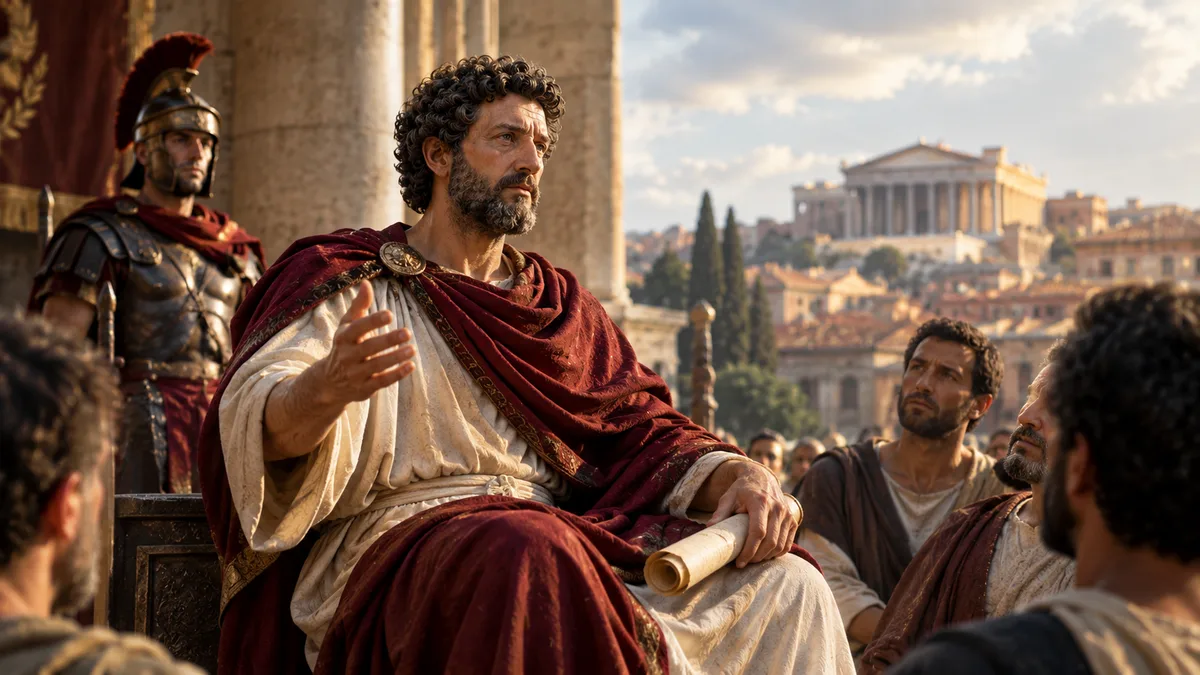
Marcus Aurelius’s leadership style emphasized duty, discipline, and responsibility. He spent much of his reign dealing with problems that demanded practical decisions rather than philosophical reflection alone. His record shows an emperor who worked to preserve the empire, but also one whose decisions had serious limitations.
Duty Over Personal Comfort
In Meditations, Marcus repeatedly reminded himself that his responsibilities mattered more than personal comfort or public praise. This outlook fits the demands of Roman government, where military emergencies and political disputes could not simply be ignored. His leadership was tested most clearly during the wars along the Danube frontier. Marcus eventually spent extended periods near the military camps, overseeing campaigns rather than remaining in Rome throughout his reign. His willingness to take responsibility during these emergencies supports his reputation for dedication.
However, commitment and success are different things. A leader can work tirelessly while making decisions that produce mixed results.
Justice, Administration, and the Senate
Marcus maintained the institutions through which Rome was governed and is associated with legal measures that addressed certain inequalities and vulnerabilities within Roman society. Surviving Roman legal materials suggest that his administration paid attention to questions involving family relationships, guardianship, and the treatment of vulnerable people. His approach to the Senate also reflected the importance of cooperation with established Roman elites. Although the emperor held enormous power, governing a large empire required officials, military commanders, and administrators who could implement decisions across distant provinces.
Still, Roman justice was not equivalent to modern equality before the law. Slavery remained legal, social status shaped people's rights, and imperial authority remained concentrated in the emperor's hands.
Marcus Aurelius’s Strengths and Weaknesses
| Area | Strengths | Limitations |
|---|---|---|
| Personal discipline | Emphasized self-control and duty | Personal virtue did not guarantee good outcomes |
| Military leadership | Personally addressed frontier threats | Wars continued to consume resources |
| Administration | Worked through Roman institutions and legal processes | Roman society remained deeply unequal |
| Crisis management | Governed through war and epidemic disease | Neither crisis could be fully overcome |
| Succession | Prepared his son for imperial rule | Commodus's reign raised serious questions about the decision |
Marcus Aurelius's record therefore resists a simple verdict. His dedication is evident in the demands of his reign, but his effectiveness must also be judged by the consequences of his policies.
The Greatest Achievements of Marcus Aurelius’s Reign
Marcus Aurelius's achievements were largely connected to preserving Roman authority during a difficult period. His government defended the frontiers, coordinated military operations, and continued administering the empire during an epidemic. These accomplishments should be understood alongside their human and financial costs.
Defending Rome During the Germanic Wars
The Germanic Wars became a defining feature of his reign. Groups including the Marcomanni and Quadi challenged Roman control along the Danube frontier, creating serious security concerns.
Marcus personally participated in the northern campaigns. Roman forces achieved important successes, but the conflicts were prolonged, and frontier security remained an ongoing concern. These campaigns demonstrate the demands of his military leadership. They also show the limits of judging an emperor solely by victories: successful defense could preserve territory while still costing lives, money, and years of sustained effort.
Managing a Public Health Crisis
The Antonine Plague spread through the Roman world during Marcus's reign, beginning around AD 165–166. Its exact cause and total death toll remain subjects of historical investigation, although smallpox is a leading explanation.
The epidemic affected civilians and military personnel, complicating recruitment, economic activity, and administration. Marcus had to govern while the empire faced both disease and military pressure. The fact that Rome continued functioning through these crises is relevant to his record, but the surviving evidence does not justify attributing every aspect of the response to his personal decisions.
Taken together, Marcus Aurelius's achievements show an emperor who maintained imperial government under difficult conditions. They do not establish that every policy was successful or that the suffering of the period could have been avoided.
Marcus Aurelius as a Stoic: How Philosophy Shaped His Decisions
Marcus Aurelius was a Stoic, but he did not treat philosophy merely as an intellectual subject. He used it as a discipline for examining his judgments, correcting his behavior, and fulfilling his responsibilities. His surviving writings show how seriously he took the challenge of living according to his principles.
Stoic philosophy also connects with the ideas of earlier Greek thinkers. For example, explore our guide to Heraclitus’s famous quotes and the “Out of Every 100 Men” attribution to understand the importance of verifying philosophical quotations and their historical sources.
Was Marcus Aurelius a Stoic Philosopher?
Stoicism teaches that virtue, rather than wealth, status, or pleasure, is the foundation of a good life. It encourages people to examine their judgments, act rationally, and recognize their responsibilities toward others. Marcus learned from Stoic teachers, including Rusticus and Apollonius, and drew inspiration from the earlier philosopher Epictetus. His Meditations repeatedly returns to self-discipline, justice, mortality, and cooperation.
These ideas influenced his understanding of leadership. An emperor should not be guided only by ambition or popularity; he should consider what reason, duty, and the common good require.
How Stoic Principles Influenced His Leadership
Three principles are especially relevant to Marcus Aurelius's philosophy of leadership.
First, focus on what you can control. A ruler cannot determine every outcome, but can examine evidence, make decisions, and take responsibility for actions.
Second, put duty before personal glory. Marcus repeatedly reminded himself that his position required service rather than self-indulgence.
Third, treat other people as members of a shared human community. His writings emphasize cooperation and the idea that individuals have responsibilities beyond their own interests.
These principles offer a framework for evaluating his conduct, not proof that every decision he made was wise. His religious policy and choice of successor show how difficult it can be to translate philosophical ideals into political practice.
Marcus Aurelius’s Character: Kindness, Justice, and Emotional Control
Marcus Aurelius's moral character is central to his enduring reputation. His writings reveal an individual concerned with fairness, self-improvement, and cooperation. However, his philosophical aspirations must be considered alongside the consequences of his rule.
Marcus Aurelius and Justice
Marcus regarded justice as a central element of ethical conduct. His philosophy encouraged people to consider the welfare of the community rather than pursuing personal advantage at everyone else's expense.
His administrative record includes legal measures associated with protecting certain vulnerable people. Still, the Roman Empire maintained slavery and sharp divisions of social status. Its legal system did not offer equal rights in the modern sense. This contrast matters. Marcus Aurelius's moral character cannot be assessed solely through his philosophical ideals; his treatment of people and the institutions he maintained must also be examined.
Did Marcus Aurelius Practice What He Preached?
The evidence supports a mixed assessment. His writings demonstrate a serious commitment to self-discipline, but his reign also involved Christian persecution and the decision to pass imperial power to Commodus. These contradictions do not make his philosophical work meaningless. Instead, they reveal the difference between aspiring to virtue and consistently achieving it in public life.
The Stoic Virtues That Guided Marcus Aurelius’s Leadership
Stoic ethics traditionally emphasizes four cardinal virtues: wisdom, justice, courage, and temperance. Together, they provide a useful framework for understanding Marcus Aurelius's philosophy.
| Virtue | Meaning | Leadership application |
|---|---|---|
| Wisdom | Sound judgment based on reason | Weigh evidence before making difficult decisions |
| Justice | Fairness and responsibility toward others | Consider how policies affect different groups |
| Courage | Facing difficulty while acting appropriately | Address crises without allowing fear to dictate every choice |
| Temperance | Restraint and control of impulses | Resist anger, vanity, and unnecessary excess |
The Dark Side of His Reign: Wars, Plagues, and Christian Persecution
Marcus Aurelius ruled during a period of serious hardship. His military campaigns, the Antonine Plague, and the persecution of Christians complicate his reputation as a philosopher committed to reason and justice.
Marcus Aurelius and Christian Persecution
One of the most troubling aspects of his reign is the persecution of Christians. Christians faced prosecution and violence in several locations, including Lyon and Vienne in Roman Gaul. The extent of Marcus's personal responsibility for particular incidents remains debated. Historians examine Christian accounts, Roman legal practices, and the relationship between local officials and imperial authority. The evidence does not support a simplistic claim that he personally directed every persecution, but neither should the suffering that occurred under his rule be dismissed.
This issue creates a significant tension in his legacy. His philosophy emphasized rational judgment and cooperation, yet Christians could suffer severe punishment within the empire he governed. His reputation as a Stoic philosopher should not prevent an honest examination of these events.
Marcus Aurelius and Commodus: Was His Choice of Successor a Failure?
Marcus Aurelius's decision to make his son Commodus his successor remains one of the most debated aspects of his reign. It raises an important question: can a ruler be remembered for personal discipline while making a consequential political decision that produces troubling results?
Why Did Marcus Aurelius Choose Commodus?
Commodus was Marcus's biological son and was prepared for imperial rule during his father's lifetime. He became co-emperor in AD 177, before Marcus died in AD 180.
Earlier emperors had often adopted successors they considered suitable for the position. Marcus's decision to pass power to his son returned Rome to hereditary succession after several emperors had been selected through adoption. The reasons behind his decision cannot be established with certainty. Family expectations, political stability, and the practical realities of succession may have mattered, but it would be misleading to present any single explanation as proven.
What Changed Under Commodus?
Commodus's reign developed a different political reputation from his father's. His relationship with the Senate deteriorated, and his rule became associated with political conflict and personal display. His assassination in AD 192 was followed by further instability. However, not every problem that emerged after Marcus's death can automatically be attributed to his father's policies.
The important point is that the succession decision exposed the risks of relying on hereditary inheritance rather than ensuring that imperial power would pass to a capable and politically sustainable successor.
Was the Succession a Political Failure?
The outcome gives historians substantial reason to question Marcus's decision. Yet it does not prove that he could have predicted everything Commodus would do. The episode also highlights a broader weakness in Roman government: the empire depended heavily on the character and judgment of individual rulers, while its institutions provided limited guarantees of a stable succession.
For modern leaders, the lesson is straightforward. Succession planning should consider capability, accountability, and institutional stability, not just family ties or personal trust.
What Meditations Reveals About Marcus Aurelius’s Philosophy and Character
Meditations remains Marcus Aurelius's most influential work. Written in Greek, its twelve books contain personal reflections on virtue, mortality, responsibility, and the challenge of living according to Stoic principles. It was not written as a public leadership manual. Rather, it records an ongoing effort to examine his own behavior and remind himself how he ought to live.
Marcus Aurelius also reminds us to examine how we interpret the world around us. This idea connects with the philosophical debate explored in If a Tree Falls in a Forest, Does It Make a Sound? The Philosophy Behind the Question, which examines the difference between physical reality and our perception of it.
Do His Writings Prove He Was a Good Emperor?
No. Meditations helps readers understand Marcus's philosophical aspirations, but it cannot serve as a complete record of his public conduct. To assess his reign, readers must also consider historical evidence concerning administration, military campaigns, religious policy, and succession. His writings offer one perspective; the consequences of his decisions provide another.
Marcus Aurelius Among the Five Good Emperors: A Lasting Legacy
Marcus Aurelius is traditionally counted among Rome's Five Good Emperors, alongside Nerva, Trajan, Hadrian, and Antoninus Pius. This historical grouping reflects a reputation for comparatively stable imperial government, but it does not mean that these rulers were free from serious controversies.
What Made Marcus Aurelius Different?
Marcus combined the responsibilities of imperial government with a sustained interest in philosophy. His writings offer an unusually personal view of how a Roman emperor understood duty, justice, self-discipline, and mortality. His reign also differed from the more peaceful years associated with some predecessors. Frontier warfare and epidemic disease placed considerable pressure on the empire, while his succession decision complicated the assessment of his political judgment.
How to Apply This in Daily Life
- 1Reflect on this Stoic exercise each morning before starting your tasks.
- 2Apply the dichotomy of control when navigating unexpected setbacks or decisions.
- 3Journal your reflections in the evening to reinforce clarity and discipline.
Frequently Asked Questions
Concluding Thoughts
So, was Marcus Aurelius a good emperor? His reign provides evidence of dedication, philosophical discipline, and a serious commitment to preserving the Roman Empire during difficult circumstances. His writings remain valuable because they explore the responsibilities and personal struggles associated with trying to live according to ethical principles.
Yet his record also includes prolonged warfare, Christian persecution, and a succession decision that contributed to his complicated legacy. These issues prevent a complete assessment based on his philosophy alone. The most useful lesson from Marcus Aurelius is that leadership requires more than good intentions. Principles matter, but so do decisions, their consequences, and the willingness to examine where ideals fall short in practice.

Hi, I’m Mehrab Khursheed, a professional Content Writer and Digital Marketing Expert with 4 years of experience in the digital industry. I studied at The Islamia University of Bahawalpur. I specialize in creating engaging, actionable content on practical Stoicism, mental resilience, personal growth, and philosophical frameworks for modern life.