
What Does Eudaimonia Mean in Ancient Greek Philosophy?
Eudaimonia is an ancient Greek philosophical concept that refers to living well and achieving human flourishing through virtue, reason, and meaningful activity. Often translated as happiness, it describes something broader than a pleasant mood: the overall quality of a person's life and how well they fulfill their human potential.
The word comes from ancient Greek and is commonly transliterated as eudaimonia. Its meaning is difficult to capture in a single English word because it combines ideas of well-being, living well, and flourishing.
In ancient Greek philosophy, the central question wasn't simply how to feel happier. Philosophers wanted to understand what makes a human life genuinely good. Is it pleasure, wealth, honor, knowledge, moral excellence, or something else? Eudaimonia became a central concept in this discussion. Philosophers such as Socrates, Plato, and Aristotle explored the relationship between virtue and the good life, while the later Stoics developed their own account of flourishing through reason and ethical character.
The Meaning and Origin of the Greek Word Eudaimonia
The Greek word eudaimonia is traditionally translated as happiness, but modern philosophical discussions often prefer flourishing or living well. These translations help distinguish the concept from happiness understood as a temporary emotional state.
The word is commonly analyzed through its Greek components, eu, meaning good or well, and daimōn, a term with a range of meanings that can include a spirit or divine power. However, its philosophical meaning cannot be reduced to a literal translation of those parts.
In ethical philosophy, eudaimonia describes a life that goes well as a whole. It involves more than feeling satisfied with your circumstances. It concerns how you act, the character you develop, and whether your activities contribute to a worthwhile life.
For example, someone might feel disappointed after telling the truth about a mistake at work, especially if doing so leads to criticism. Yet that person may still be living well in an important ethical sense because they acted honestly and accepted responsibility.
This illustrates a central distinction: a good life is not necessarily a life in which every moment feels good.
What Does Human Flourishing Mean in Philosophy?
Human flourishing refers to living well in a broad and lasting sense. It includes how people use their abilities, develop their character, maintain relationships, and pursue worthwhile activities. Flourishing isn't identical to professional success or financial comfort. A person can have an impressive career yet struggle with dishonesty, isolation, or a lack of purpose. Another person may live modestly while cultivating strong relationships, acting responsibly, and finding meaning in everyday work.
Different philosophical traditions explain flourishing differently. Aristotle emphasizes virtuous activity and the development of human capacities. Stoicism places particular importance on rational judgment and moral virtue. Both approaches encourage readers to look beyond immediate gratification when evaluating the quality of a life.
““Happiness is an activity of the soul in accordance with perfect virtue.””
— Aristotle, Nicomachean Ethics, Book I, Chapter 13
Note on context: For Aristotle, eudaimonia means more than feeling happy or experiencing temporary pleasure. It involves living well by using reason, developing good character, and acting virtuously. A flourishing life is built through consistent choices and habits that help a person fulfill their human potential.
Key Takeaway: True flourishing comes from living virtuously, using reason, and developing good character, not simply from pursuing pleasure.
- Practice honesty and fairness in everyday decisions.
- Focus on long-term well-being rather than temporary pleasure.
How Do You Pronounce Eudaimonia?

Eudaimonia is commonly pronounced yoo-dye-MOH-nee-uh in English, although pronunciations vary.
You can break the word into syllables as follows:
- Yoo: The opening sound.
- Dye: The second syllable.
- Moh: The stressed syllable in this common English pronunciation.
- Nee-uh: The ending.
The term appears frequently in discussions of Aristotle, Stoicism, and virtue ethics. Learning its pronunciation makes it easier to follow philosophical lectures, podcasts, and conversations about the Greek concept of happiness. Keep in mind that a modern English pronunciation is a practical guide, not an exact reconstruction of how every ancient Greek speaker would have pronounced the word.
Why Eudaimonia Means More Than Happiness
Eudaimonia is often translated as happiness, but the translation can be misleading if happiness means feeling cheerful, satisfied, or excited.
A person can experience grief, disappointment, or anxiety while still living a life guided by meaningful commitments and strong moral character. Conversely, someone can experience frequent pleasure without developing the qualities that make a life ethically worthwhile. The distinction is especially important in Aristotle's theory of happiness and Stoic philosophy. Both traditions ask what makes life good overall, rather than treating positive feelings as the only measure of well-being.
Eudaimonia vs. Pleasure, Positive Emotions, and Life Satisfaction
These concepts overlap, but they emphasize different aspects of human experience.
| Concept | Main emphasis | Example |
| Eudaimonia | Living well through virtue and worthwhile activity | Building an honest, responsible, and meaningful life |
| Pleasure | Enjoyment or satisfaction from an experience | Enjoying a favorite meal |
| Emotional happiness | A positive emotional state | Feeling excited about good news |
| Life satisfaction | A person's overall evaluation of their life | Feeling satisfied with one's relationships and progress |
Pleasure can contribute to a good life. Friendship, recreation, achievement, and enjoyable experiences all have a place in human well-being. The distinction is that pleasure alone doesn't determine whether a life is flourishing.
Imagine a student who spends an evening enjoying a party but neglects an important responsibility. The pleasure is real, yet it doesn't automatically make the choice wise. By contrast, studying for a difficult examination may be frustrating in the moment but support a worthwhile long-term goal. Neither example proves that work is always better than pleasure. The philosophical point is that the value of an activity depends partly on how it fits into a well-lived life.
Is Eudaimonia the Same as Living a Meaningful Life?
Eudaimonia and a meaningful life are closely related, but they aren't interchangeable in every philosophical context. A meaningful life usually involves purpose, significance, or commitments that matter to a person. Eudaimonia, especially in Aristotle's ethics, also involves how a person lives and acts. Having a strong personal purpose doesn't necessarily mean that the purpose is virtuous or that the person is flourishing in every relevant respect.
For example, someone might dedicate years to building a successful business. If that person also treats employees fairly, maintains important relationships, and develops good judgment, their work may contribute to a flourishing life. If success depends on exploitation and dishonesty, the same achievement raises ethical questions. This is why eudaimonia asks more than whether you have goals. It asks whether your way of pursuing them contributes to living well.
““Happiness is the highest good.””
— Aristotle, Nicomachean Ethics, Book I, Chapter 7 (1097b).
Note on context: Aristotle’s concept of eudaimonia goes beyond temporary happiness or pleasure. It describes a flourishing life built through virtue, reason, meaningful activity, and good character. A person can experience pleasure without truly flourishing; eudaimonia concerns how well a person lives overall.
Key Takeaway: Eudaimonia is not simply feeling happy; it is living well and developing the virtues that make a life meaningful.
- Develop habits that support long-term well-being.
- Find meaning in purposeful and worthwhile activities.
Aristotle’s Definition of Eudaimonia in the Nicomachean Ethics
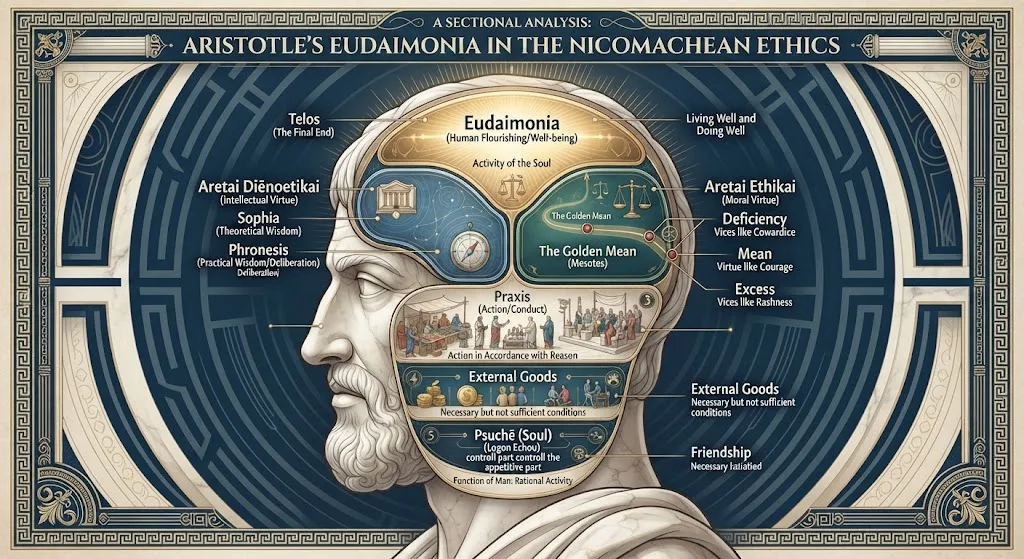
Aristotle's most influential account of eudaimonia appears in the Nicomachean Ethics. In this work, he investigates the highest good humans pursue and asks what kind of life allows people to fulfill their distinctive capacities. His answer is not simply that happiness comes from feeling good, acquiring wealth, or gaining public recognition. Instead, Aristotle defines the good life through activity of the soul in accordance with virtue over a complete life. Reason and excellent character are central to this account.
Why Aristotle Calls Eudaimonia the Highest Human Good
Aristotle begins with an observation: people pursue many different goals. We seek money, knowledge, health, pleasure, friendship, and professional achievement. Often, we pursue one thing because we believe it will help us obtain something else.
Money, for example, can provide security and opportunities. Education can develop our abilities and open professional doors. Recognition can help us gain influence. But Aristotle asks whether there is an ultimate goal that makes these smaller goals worthwhile. He identifies eudaimonia as the highest human good because we seek it for its own sake, rather than merely as a means to another end.
This doesn't mean every person consciously defines happiness in the same way. People disagree about what makes life good. Aristotle's task is to examine those disagreements and develop a philosophical account of what flourishing actually involves. His argument also explains why external achievements aren't sufficient by themselves. A person might possess wealth and recognition yet lack good judgment or act unjustly. From Aristotle's perspective, having desirable possessions doesn't automatically mean living well.
The Function Argument: What Makes Human Life Distinctive?
Aristotle develops his account through the function argument. He asks what distinguishes human beings and what it means for humans to perform their characteristic activities well. Plants grow and sustain themselves. Animals also perceive their surroundings and move. Human beings share these capacities, but Aristotle emphasizes our ability to reason and guide our actions through thought. He therefore connects human flourishing with rational activity performed in accordance with virtue. A good human life involves using reason well, developing character, and choosing appropriate actions.
Consider a person who has the ability to lead a team. Their leadership could involve setting clear goals, listening to colleagues, making fair decisions, and accepting responsibility for mistakes. These actions demonstrate more than technical competence. They show how practical judgment and ethical character can shape the use of an ability. The function argument doesn't claim that humans must be productive every moment. Rather, it connects flourishing with the excellent exercise of human capacities over time.
Why Eudaimonia Requires a Complete Life
For Aristotle, flourishing isn't adequately measured by a single successful day, a promotion, or a moment of excitement. His account concerns the quality of a life as a whole.
A person might make an admirable decision today but struggle to maintain good character over time. Another might experience temporary setbacks while consistently acting with courage, generosity, and sound judgment. The broader pattern matters.
Aristotle also recognizes that fortune and external circumstances can affect how well a person lives. Serious misfortune can limit opportunities for virtuous activity and damage important relationships. This makes his theory more complicated than the claim that good character guarantees a life free from hardship. The practical lesson is to evaluate life through sustained actions, character, and worthwhile activity rather than isolated victories or disappointments.
How Aristotle Connects Virtue, Reason, and the Good Life
Aristotle's theory of happiness depends on the relationship between reason and virtue ethics. Virtue is not merely a list of rules to memorize. It involves developing the character and judgment needed to act well in different circumstances. Someone can understand that honesty is valuable but still lie when telling the truth becomes uncomfortable. Aristotle's approach asks how people can develop the habits, emotional responses, and practical judgment that make ethical action more consistent.
Moral Virtues and the Development of Good Character
Aristotle argues that many moral virtues develop through habituation. We become more capable of acting well by repeatedly practicing appropriate actions and learning from experience.
Consider generosity. Giving money away without thought isn't always generous in the fullest sense. A person must also consider their responsibilities, the needs of others, and whether their actions are appropriate to the circumstances. The same applies to courage. Courage isn't the absence of fear, nor is it the willingness to take every risk. It involves responding to danger appropriately for a worthwhile purpose.
Aristotle discusses several virtues, including:
- Courage:
Responding appropriately to fear and danger. - Temperance:
Regulating desires and pleasures through sound judgment. - Justice:
Treating people fairly and fulfilling relevant obligations. - Generosity:
Using resources appropriately and giving in a fitting way.
These qualities become part of a person's character through practice, education, and experience. Virtuous living is therefore an ongoing process rather than a status achieved through one good decision.
Practical Wisdom and the Golden Mean
Aristotle uses the concept of phronesis, usually translated as practical wisdom, to explain how people make good decisions in complex situations.
General principles can help, but real life rarely presents choices in perfectly predictable forms. Practical wisdom helps a person recognize which considerations matter, understand the circumstances, and choose an appropriate response. This idea connects with Aristotle's doctrine of the mean. Many virtues lie between two extremes: one involving excess and the other deficiency.
Courage, for example, can be understood as a fitting response between recklessness and cowardice. A reckless person may ignore genuine danger, while a cowardly person may retreat even when action is justified. The courageous person assesses the situation and responds appropriately.
The mean isn't a fixed midpoint that works for everyone. What counts as a fitting response depends on the circumstances, the person, and the purpose of the action. Practical wisdom also helps explain why ethical living requires experience. Reading about honesty or justice is useful, but applying those principles well involves learning how they work in actual situations.
Why Virtue Alone Does Not Tell the Whole Aristotelian Story
Aristotle places virtue at the center of eudaimonia, but his theory also recognizes the importance of other goods.
Friendship, adequate material resources, opportunities for action, and some degree of favorable fortune can contribute to a flourishing life. His account doesn't reduce human well-being to moral character in isolation.
He also gives an important role to contemplation, or the thoughtful pursuit of understanding, particularly in Book X of the Nicomachean Ethics. His discussion of the best life is therefore richer than a simple checklist of moral habits. This is one of the major differences between Aristotle and the Stoics. Aristotle treats virtue as essential to flourishing but recognizes that external misfortunes can affect how fully a person flourishes. The Stoics make the stronger claim that virtue is sufficient for happiness.
““The good for man is an activity of the soul in accordance with virtue.””
— Aristotle, Nicomachean Ethics, Book I, Chapter 7 (1098a16–17).
Note on context: Aristotle argues that living a good life requires more than pleasure, wealth, or success. Human beings flourish by using reason well and developing virtues such as courage, justice, and self-control. These qualities guide our actions and help us make sound decisions.
Key Takeaway: A good life develops through rational thinking, virtuous actions, and consistent efforts to become a better person.
- Balance emotions with thoughtful judgment.
- Focus on becoming a person of good character rather than pursuing external success alone.
Eudaimonia in Stoicism: Living According to Nature
In Stoic philosophy, eudaimonia is closely connected with living according to nature. This means using reason well, developing virtue, and acting in ways consistent with human rational and social capacities. The Stoics believed that people often become distressed when they treat things outside their control, such as public opinion or the final outcome of an effort, as the foundation of a good life. Their philosophy encourages people to focus on sound judgment and responsible action instead.
However, Stoicism isn't simply about suppressing feelings or pretending that difficulties don't matter. It offers an ethical framework for evaluating judgments, managing responses, and acting appropriately even when circumstances are challenging.
Stoicism and Buddhism offer different approaches to suffering, mindfulness, and inner peace. Read our guide to [Stoicism and Buddhism: similarities and differences] to explore how these two philosophical traditions compare in their views on virtue, emotional resilience, and living a meaningful life.
What Does Living According to Nature Mean for the Stoics?
For the Stoics, living according to nature involves two connected ideas: living according to human reason and living in agreement with the larger order of nature. Human beings can reflect on their impulses, examine their judgments, and choose how to respond. They also live among other people, which makes cooperation, fairness, and social responsibility important parts of ethical life.
Living naturally, in this philosophical sense, doesn't mean following every instinct or avoiding technology and modern comforts. It means developing the capacities that Stoics regard as distinctive and valuable in human beings.
For example, suppose a colleague receives recognition for work you contributed to. You may feel frustrated or jealous. A Stoic approach would involve examining the situation, deciding what response is justified, and addressing the problem fairly if necessary.
You don't have to pretend the situation is acceptable. You can seek clarification, advocate for yourself, and correct an injustice. The aim is to avoid letting resentment determine your conduct.
The Four Stoic Virtues and Human Flourishing
Stoic ethics identifies four cardinal virtues: wisdom, courage, justice, and temperance. They describe different aspects of excellent judgment and character.
Wisdom involves understanding what matters, evaluating situations accurately, and making sound judgments. It helps distinguish genuine moral concerns from matters of preference or reputation. Courage means doing what is right despite fear, discomfort, or uncertainty. It can involve speaking honestly, protecting someone vulnerable, or accepting the consequences of a responsible decision.
Justice involves treating others fairly, respecting obligations, and recognizing that ethical living includes responsibilities toward other people. Temperance means exercising appropriate self-control over desires, pleasures, and impulses. It allows people to pursue worthwhile aims without becoming ruled by immediate gratification. The Stoics understood these virtues as deeply interconnected. A person who appears courageous but acts recklessly lacks the wisdom needed to judge danger. Someone who claims to be wise but treats others unjustly hasn't achieved the full excellence Stoic ethics demands.
What Epictetus, Seneca, and Marcus Aurelius Teach About the Good Life
Three influential Stoic thinkers offer useful perspectives on applying these ideas.
Epictetus emphasizes the distinction between our own judgments and choices and things that aren't fully within our control. His teaching encourages people to examine their responses rather than making their well-being depend entirely on other people's behavior. Seneca writes about time, moral development, anger, and the use of wealth. His work encourages readers to consider whether they are using their time and resources wisely rather than simply pursuing more.
Marcus Aurelius, a Roman emperor, records personal reflections on duty, self-discipline, mortality, and cooperation with others in his Meditations. His position of power makes the contrast especially striking: public influence and political authority don't remove the need for ethical judgment. These philosophers don't offer identical advice in every respect, but they share a commitment to improving the quality of one's judgments and actions.
For a practical example, imagine receiving harsh feedback at work. An Epictetus-inspired response would examine what can be learned and controlled. A Seneca-inspired reflection might question whether pride or anger is consuming too much attention. A Marcus Aurelius-inspired approach might emphasize fulfilling your responsibilities without turning the disagreement into a personal feud.
These are modern applications of their ideas, not direct quotations from their writings.
Why Stoics Believe Virtue Is Sufficient for Happiness
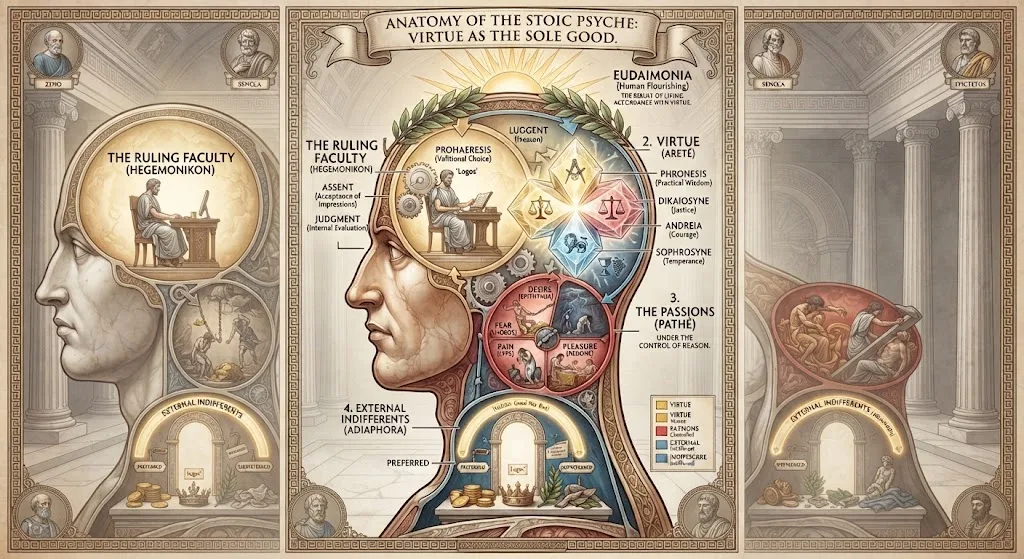
One of the most distinctive Stoic teachings is that virtue is sufficient for happiness. In this context, happiness means eudaimonia: a flourishing life grounded in moral excellence and rational judgment. The Stoics argue that external circumstances cannot, by themselves, make someone a good or bad person. Wealth, health, reputation, and success may be desirable, but they don't determine whether someone acts wisely or justly.
This is a stronger position than Aristotle's. Aristotle considers virtue essential to a good life while allowing that severe misfortune can undermine flourishing. The Stoics argue that genuine virtue is sufficient for happiness even under extremely difficult conditions.
What the Stoics Mean by Virtue as the Only Good
The Stoics distinguish between what is morally good and what is merely desirable or undesirable.
Wisdom, justice, courage, and temperance are genuine goods because they express excellent reason and character. By contrast, wealth, fame, physical appearance, and professional status don't automatically make someone morally better.
Imagine two business owners. One earns millions but deceives customers and exploits employees. The other earns a modest income while treating people fairly, fulfilling commitments, and making responsible decisions. The first person has greater financial success, but that alone doesn't establish that they are living better in the Stoic ethical sense.
The second person's income doesn't guarantee virtue either. The point is that moral character, rather than material success, determines the ethical quality of a person's choices. Stoic virtue also requires more than good intentions. It involves sound judgment about what matters and the ability to act consistently with that judgment.
Are Health, Wealth, and Reputation Irrelevant to Stoics?
The Stoics classify many external conditions as indifferents. This doesn't mean that every external condition is equally desirable in ordinary life or that people should stop caring about their health and responsibilities.
Instead, Stoics distinguish between something that is naturally preferable and something that is morally good in the strict sense.
For example, health is generally preferable to illness. Financial security can help someone support a family, obtain necessities, and contribute to a community. A good reputation can make cooperation easier.
These are known as preferred indifferents. They can be reasonably pursued, but possessing them doesn't automatically produce virtue or guarantee happiness. Consider someone who loses a job despite performing well. A Stoic approach doesn't require pretending that unemployment is desirable. The person can look for work, seek financial assistance, ask for support, and challenge an unfair dismissal where appropriate.
The philosophical distinction is that the outcome and the person's ethical response are not the same thing. Losing a job may cause real hardship, but it doesn't force the person to act dishonestly or abandon their responsibilities.
How Stoicism Responds to Suffering and Uncertainty
Stoicism encourages people to examine their judgments and respond thoughtfully to circumstances they cannot fully control. It doesn't promise that hardship will stop hurting or that every problem can be solved through a change in attitude.
Consider a person caring for a seriously ill family member. They may feel exhausted, frightened, and grief-stricken. Stoic principles might help them distinguish between responsible actions they can take and outcomes they cannot guarantee. They can seek medical care, ask relatives for help, and make thoughtful decisions while acknowledging their emotional limits. They don't need to deny their sadness to practice courage or justice.
This distinction matters because Stoicism is sometimes misunderstood as emotional suppression. Its deeper aim is to develop sound judgment and appropriate responses, not to make people indifferent to suffering.
To explore these ideas in more detail, read our guide to [Stoic Terms: Essential Stoic Philosophy Concepts and Their Meanings], which explains key concepts such as arete (virtue), logos (reason), and apatheia (freedom from destructive passions).
Aristotle vs. Stoicism: Two Views of Human Flourishing
Aristotle and the Stoics share a central conviction: a good life requires more than pleasure, wealth, or public recognition. Both place reason and virtue at the center of ethical living. Their main disagreement concerns whether virtue alone is sufficient for complete flourishing or whether external circumstances also contribute to the good life.
| Philosophical question | Aristotle | Stoicism |
| What is eudaimonia? | Living well through excellent activity in accordance with virtue over a complete life | Living well through virtue and agreement with reason and nature |
| Is virtue essential? | Yes, virtue is central to flourishing | Yes, virtue is the only genuine good |
| Do external goods matter? | Yes, some external goods support flourishing | They can be preferred, but they don't determine happiness |
| What role does reason play? | Reason guides action, practical judgment, and excellent activity | Reason guides judgments and virtuous choices in accordance with nature |
| How should hardship be approached? | Hardship can diminish opportunities for flourishing | Hardship doesn't destroy genuine happiness when virtue is maintained |
| What supports a good life? | Virtue, rational activity, friendship, and appropriate external conditions | Virtue, sound judgment, and living according to nature |
These summaries describe the broad positions of each tradition. Both philosophies contain further debates and distinctions.
What Aristotle and the Stoics Agree On
Both traditions reject the idea that a good life can be measured by pleasure or possessions alone.
Aristotle argues that human flourishing involves rational activity and virtue. The Stoics likewise emphasize excellent character and rational judgment, although they define the relationship between virtue and happiness more strictly. Both approaches also take ethical development seriously. People must learn to judge situations well, regulate their responses, and act responsibly. A person's character is revealed not just by what they say they value but by how they behave.
For example, someone who wants to be considered fair must do more than express support for fairness. They must apply it when making difficult decisions, especially when fairness conflicts with personal advantage.
The Main Difference: External Goods and the Sufficiency of Virtue
Aristotle recognizes that flourishing requires some favorable conditions. Friendship, resources, health, and opportunities can make it possible to engage in worthwhile activities. Severe misfortune may prevent someone from exercising their capacities fully.
The Stoics draw a sharper line between ethical goodness and external success. A person's health or wealth may change, but those changes don't inherently make the person more or less virtuous. This doesn't mean Aristotle believes wealthy people are automatically happier, or that Stoics believe people should ignore their practical needs. Both views are more nuanced than those stereotypes suggest.
The difference is about what ultimately determines a good life. Aristotle gives external goods a role in flourishing, while the Stoics maintain that virtue is sufficient for genuine happiness.
Which Approach Offers a More Useful Guide to Modern Life?
The answer depends partly on the question you're trying to resolve.
Aristotle offers a useful framework for thinking about the different parts of a flourishing life. His emphasis on friendship, practical wisdom, character, and meaningful activity encourages you to consider how your relationships and circumstances fit together. Stoicism offers a particularly useful framework for dealing with uncertainty. It encourages you to focus on responsible action without making your entire sense of well-being dependent on recognition, success, or outcomes you cannot guarantee.
Imagine that you apply for a promotion and don't receive it. An Aristotelian perspective might encourage you to assess your professional development, relationships, judgment, and broader life goals. A Stoic perspective might encourage you to examine whether you acted honestly, prepared appropriately, and responded fairly to the decision. These approaches can complement one another in practical life, even though their underlying theories of happiness differ.
““We must not listen to those who advise us, being men, to think of human things, and, being mortal, of mortal things, but must, so far as we can, make ourselves immortal.””
— Aristotle, Nicomachean Ethics, Book X, Chapter 7 (1177b31–34).
Note on context: Aristotle emphasizes developing the highest capacities of human reason as part of the good life. Stoicism also values reason, but places particular emphasis on living virtuously in agreement with nature and accepting what lies beyond our control. The two traditions share important ideas while differing in what they consider essential to flourishing.
Key Takeaway: Aristotle highlights the fulfillment of human rational capacities, while Stoicism emphasizes virtue and wise responses to life’s circumstances.
- Use reason to guide important decisions.
- Develop your intellectual and moral abilities.
The Role of Health, Wealth, Friendship, and External Circumstances

A philosophical account of flourishing must address the conditions in which people actually live. Health, income, relationships, and opportunities affect what people can do and the difficulties they face. Aristotle explicitly recognizes this complexity. Stoicism, meanwhile, distinguishes between the practical value of external conditions and their role in determining moral goodness.
Understanding both perspectives helps avoid two extremes: assuming that money guarantees a good life or pretending that material conditions have no meaningful consequences.
Why Friendship Matters to a Flourishing Life
Aristotle devotes substantial attention to friendship in the Nicomachean Ethics. He distinguishes friendships based on usefulness, pleasure, and appreciation of the other person's character. A useful friendship may develop between colleagues who help each other professionally. A friendship based on pleasure may grow from shared interests and enjoyable experiences. A deeper friendship of character involves mutual goodwill and appreciation of one another as people.
These forms of friendship can overlap. However, Aristotle considers friendships grounded in good character especially valuable because each person wishes the other well for the other's own sake. Friendship contributes to flourishing through shared activity, support, honest feedback, and opportunities to practice virtue. It also reminds us that a meaningful life isn't solely an individual achievement.
Stoic ethics likewise recognizes social responsibilities. Although Stoicism emphasizes the independence of virtue from external outcomes, it doesn't encourage people to abandon family, friends, or their communities.
How Health and Material Security Affect Human Flourishing
Health and financial resources can support a good life by making certain activities possible. Adequate housing, food, medical care, and time for relationships can provide a foundation for pursuing meaningful goals.
However, these conditions don't guarantee wisdom, integrity, or satisfaction. A person may have considerable wealth while neglecting important relationships or acting unjustly. Aristotle's view helps explain why material circumstances can matter without being the ultimate purpose of life. Resources can support flourishing, but they don't replace virtuous activity.
The Stoic view offers a different emphasis: pursue health and reasonable security where appropriate, but don't make your moral worth depend on obtaining them. Neither approach requires blaming people for circumstances beyond their control. Financial hardship, illness, discrimination, and other barriers can create genuine limitations. Philosophy can help clarify values and responses, but it doesn't eliminate these challenges.
Can You Flourish During Adversity?
Aristotle and the Stoics approach this question differently.
For Aristotle, a person can demonstrate courage, justice, and other virtues during hardship. Nevertheless, severe misfortune may limit the person's ability to flourish fully because some external goods contribute to the good life. The Stoics maintain that virtue remains sufficient for happiness even when external conditions are extremely unfavorable. They distinguish moral goodness from comfort, health, or public success.
Consider two people facing financial difficulty. Both may experience stress and uncertainty. One becomes dishonest in an attempt to escape the situation quickly. The other seeks assistance, makes realistic plans, and treats others fairly while working through the problem. The second response illustrates qualities valued by both traditions, even though Aristotle and the Stoics would explain their significance differently.
This example doesn't suggest that ethical behavior automatically resolves financial problems. It shows how character and circumstances can be considered separately without pretending they are unrelated.
How Socrates and Plato Influenced the Philosophy of Eudaimonia
The development of eudaimonia in ancient Greek philosophy didn't begin with Aristotle or the Stoics. Earlier thinkers, especially Socrates and Plato, explored the relationship between virtue, justice, reason, and living well. Their ideas helped shape later ethical debates, although each philosopher developed a distinct account of what makes a life good.
Socrates and the Importance of Examining Your Life
Socrates is associated with the view that people should examine their beliefs, question their assumptions, and take the condition of their character seriously.
In Plato's dialogues, Socrates challenges the idea that wealth, power, or reputation automatically makes someone good. He asks whether a person who gains external success through injustice can genuinely be considered better off than someone who acts ethically. His approach places self-examination at the center of philosophical inquiry. Instead of accepting popular ideas about success, people should ask what justice requires and whether their choices reflect sound judgment.
This connects with eudaimonia because it shifts attention from appearances to the quality of a person's life and character. It is worth remembering that Socrates left no surviving writings of his own. Much of what we know about his philosophy comes through accounts by Plato and other ancient authors, so his historical views must be distinguished from the arguments presented by those writers.
Plato on Justice, the Soul, and the Good Life
Plato develops questions about justice and flourishing in works such as the Republic. One of the dialogue's central concerns is whether a just life is genuinely better than an unjust one, even when injustice appears to offer material advantages.
In the Republic, Plato connects justice in an individual with the proper ordering of the soul. Reason should guide the person rather than allowing competing desires to dominate every decision. This doesn't mean Plato expects people to eliminate all desires or emotions. His account concerns how different aspects of human motivation should be organized and guided.
For example, someone might desire financial success while also recognizing obligations to family and community. A well-ordered life requires more than satisfying the strongest desire of the moment. It requires judgment about how different aims fit together.
From Socrates and Plato to Aristotle and the Stoics
Aristotle studied with Plato but developed his own approach to ethics. He retained the importance of virtue and rational activity while rejecting certain aspects of Plato's metaphysics. The Stoics emerged later and developed another distinctive account of flourishing. They agreed that reason and virtue are central but argued that virtue alone is sufficient for happiness.
The broad historical progression can be summarized as follows:
- Socrates:
Emphasized examining one's beliefs and caring about virtue and the soul. - Plato:
Developed an account of justice, rational order, and the good life. - Aristotle:
Explained flourishing through rational activity, virtue, and the role of external goods. - The Stoics:
Emphasized virtue, rational judgment, and living according to nature as the foundation of happiness.
These aren't identical theories passed unchanged from one thinker to another. They represent an ongoing philosophical debate about what humans should value and how they should live.
Practical Examples of Eudaimonia in Everyday Life
Eudaimonia can seem abstract until you connect it with everyday decisions. Its practical relevance becomes clearer when you ask not only what outcome you want but also what kind of action is appropriate and what sort of person you are becoming. The following examples illustrate how Aristotelian and Stoic ideas can inform ordinary situations. They are hypothetical scenarios, not empirical case studies.
Eudaimonia at Work: Choosing Integrity Over Recognition
Imagine that you discover an error in a report shortly before an important presentation. Correcting it could delay the project and attract criticism from your manager.
You have two options. You could hide the mistake and hope nobody notices, or you could disclose it, explain its implications, and help correct the problem. An Aristotelian approach would emphasize honesty, responsibility, and practical wisdom in deciding how to handle the situation. A Stoic approach would emphasize acting justly and courageously regardless of whether the decision leads to praise or criticism.
Both perspectives encourage you to look beyond immediate convenience. However, neither guarantees that honesty will lead to a promotion or protect you from unfair treatment. The value of the decision lies partly in the quality of your judgment and conduct, not just in the final outcome.
Eudaimonia in Relationships: Practicing Justice and Friendship
Suppose a close friend repeatedly asks for help but rarely respects your time or offers support in return. A flourishing relationship requires more than pleasing the other person. You may need to communicate honestly, establish boundaries, and decide what kind of support is reasonable.
Aristotle's account of friendship can help you consider whether the relationship includes mutual goodwill and respect. Stoic ethics can encourage you to respond fairly without allowing anger or resentment to dictate your behavior. This doesn't mean tolerating harmful treatment in the name of virtue. Acting justly includes taking your own responsibilities and well-being seriously.
In practice, eudaimonia may involve being generous when appropriate and saying no when necessary.
Eudaimonia During Failure, Conflict, and Uncertainty
Imagine preparing carefully for an examination but receiving a disappointing result. One response is to treat the outcome as proof that you're incapable. Another is to examine what happened, identify what can be improved, and make a realistic plan for the next attempt.
An Aristotelian approach encourages the development of good habits, sound judgment, and persistence in worthwhile activities. A Stoic approach encourages you to distinguish your preparation and choices from the final result, which may also depend on circumstances beyond your control. Neither approach requires denying disappointment. Emotions can provide information about what matters to us, even when they don't determine the best response.
The practical goal is to learn from failure without allowing a single result to define your entire life.
Eudaimonia Through Learning, Service, and Personal Growth
Flourishing can also emerge through activities that develop your abilities and strengthen your contribution to others. Learning a difficult skill may build patience and competence. Helping a neighbor may express generosity and social responsibility. Taking time to understand a different perspective may improve your judgment.
These activities don't automatically produce eudaimonia, and no single lifestyle suits everyone. Their value depends partly on how they fit into a person's responsibilities, character, and broader aims. The central idea is that a meaningful life involves more than accumulating achievements. It also involves how you use your abilities, treat people, and engage with the world around you.
How to Apply Eudaimonia to Build a More Meaningful Life
You don't need to become an ancient philosopher to apply eudaimonia to daily life. You can begin by reflecting on your values, practicing good judgment, and examining whether your choices support the kind of life you want to lead. The aim isn't constant happiness or moral perfection. It's to develop a more thoughtful and consistent approach to living well.
Identify What a Good Life Means Beyond Immediate Pleasure
Start by asking what makes your life worthwhile beyond the rewards of the moment. You might value meaningful work, close relationships, learning, service, creativity, or the ability to act with integrity. These values can help you evaluate decisions that offer immediate pleasure but conflict with longer-term priorities.
For example, accepting every professional opportunity might increase your income but leave little time for family or personal development. Declining some opportunities may help you protect other important parts of your life.
The answer isn't always obvious. Eudaimonia encourages you to examine the trade-offs rather than assuming that more money, status, or activity is automatically better.
Practice Wisdom, Courage, Justice, and Temperance
The four cardinal virtues offer a practical framework for reviewing your choices.
| Virtue | Question to ask yourself | Everyday application |
| Wisdom | What am I overlooking, and what does the situation actually require? | Check the facts before making an important decision. |
| Courage | What worthwhile action am I avoiding because I'm afraid? | Admit a mistake or speak up about an unfair practice. |
| Justice | Am I treating others fairly and meeting my responsibilities? | Give credit to colleagues for their contributions. |
| Temperance | Am I responding thoughtfully or simply following an impulse? | Pause before making an unnecessary purchase or sending an angry message. |
These questions aren't a substitute for careful judgment. They are reminders to consider the ethical dimensions of everyday decisions. Aristotle would emphasize developing these qualities through habituation and practical wisdom. A Stoic would emphasize making them consistent with rational judgment and living according to nature.
Focus on Your Choices Without Ignoring Real Circumstances
Stoic philosophy encourages you to distinguish between what you can directly influence and what you cannot fully control.
You can prepare for a job interview, but you can't guarantee that you'll be hired. You can communicate honestly in a relationship, but you can't force another person to respond fairly. This distinction helps direct your effort toward useful action rather than endless worry about outcomes.
However, recognizing limited control doesn't mean accepting preventable harm or ignoring social problems. You can seek help, challenge unfair treatment, organize with others, and work to improve difficult circumstances. The goal is to act responsibly while recognizing that effort and outcomes are not identical.
Build Habits That Support Long-Term Flourishing
Character develops through repeated choices. Small, consistent actions can help you practice the qualities you value. You might make time for a meaningful conversation, keep a commitment even when it's inconvenient, review a decision you regret, or set aside time to learn something important.
The point isn't to turn every moment into a productivity exercise. Rest, recreation, and enjoyment can also belong in a flourishing life. A useful habit is to review your decisions occasionally and ask whether your behavior matches your stated values. When it doesn't, identify one realistic adjustment rather than demanding instant perfection.
Use a Simple Daily Eudaimonia Reflection
At the end of the day, take a few minutes to consider four questions:
- Did I act with wisdom and integrity today?
- Did I treat other people fairly?
- Did I respond thoughtfully to circumstances I couldn't fully control?
- Did my choices support the kind of life I want to build?
You might also ask what went well and what you would handle differently next time. This exercise draws on themes from Aristotelian ethics and Stoicism. It isn't a scientifically validated test or a guarantee of happiness. Its purpose is to help you become more aware of your decisions and the habits they reinforce.
Over time, this kind of reflection can make philosophical ideas more concrete by connecting them with the choices you actually face.
How to Apply This in Daily Life
- 1Reflect on this Stoic exercise each morning before starting your tasks.
- 2Apply the dichotomy of control when navigating unexpected setbacks or decisions.
- 3Journal your reflections in the evening to reinforce clarity and discipline.
Frequently Asked Questions
Concluding Thoughts
Eudaimonia offers a different way to think about happiness. Instead of asking only whether you feel good or have achieved your goals, it asks whether you're living well and developing the qualities that make a life worthwhile. Aristotle connects flourishing with rational activity, virtue, friendship, and a complete life. His account recognizes that external circumstances can affect our opportunities to flourish. The Stoics share his emphasis on reason and virtue but argue that virtue alone is sufficient for genuine happiness, regardless of wealth, reputation, or other external outcomes.
Both traditions invite you to look beyond immediate gratification and consider the quality of your choices. Their practical value lies not in promising a life without disappointment but in helping you think more clearly about what matters. A useful place to begin is with a simple question: Am I merely pursuing the outcomes I want, or am I also becoming the kind of person I want to be?
That question captures the enduring appeal of eudaimonia. A good life isn't measured only by what you possess or how you feel today. It's also shaped by how you act, how you treat others, and the values you put into practice over time.

Hi, I’m Mehrab Khursheed, a professional Content Writer and Digital Marketing Expert with 4 years of experience in the digital industry. I studied at The Islamia University of Bahawalpur. I specialize in creating engaging, actionable content on practical Stoicism, mental resilience, personal growth, and philosophical frameworks for modern life.