
Is the “One Is a Warrior” Quote Really by Heraclitus?
No reliable historical evidence supports attributing the “Out of every 100 men” warrior quote to Heraclitus. Research published by Quote Investigator traces the saying to a monologue in Tracers, a play about the experiences of Vietnam veterans, rather than to an ancient Greek philosophical text. The modern attribution to Heraclitus appears in documented online records from 2003.
Heraclitus lived roughly 2,500 years before those records. His original work, commonly associated with the title On Nature, has not survived as a complete book. Scholars reconstruct his philosophy from fragments preserved in later ancient writings. That makes reliable sourcing essential when deciding whether a quotation belongs to him.
What evidence challenges the attribution?
The popular quote typically describes a group of 100 men: some are supposedly unfit for battle, most are described as targets, a smaller number are fighters, and one is singled out as a warrior who brings the others home. The wording varies across websites and publications. Some versions use “one is a warrior,” while others change the percentages, refer to a commander, or present the saying as a message from an ancient battlefield.
Quote Investigator identifies a relevant predecessor in Tracers. An Associated Press report published in January 1985 described a drill-sergeant monologue in the play using the idea that most recruits were targets, some were fighters, and one in 100 might become a warrior. The report provides a dated example of the saying’s modern development.
By contrast, the standard collections of Heraclitus’s fragments do not provide a reliable ancient source for the complete 100-men quotation. That distinction matters. A saying can sound consistent with a philosopher’s ideas without being something the philosopher actually wrote or said.
What is the verdict?
The most defensible conclusion is that the warrior quote is misattributed to Heraclitus, and its modern wording is traceable to Tracers. This does not establish the identity of every person who contributed to the wording or prove the precise moment the saying was first composed. It does, however, mean that crediting Heraclitus as its confirmed author is unsupported by the available evidence.
““One in a hundred may become a warrior. I must seek him out. I must come down heavy on him.””
— Sergeant Williams
Note on context: The passage reflects the play’s depiction of military training, combat, and the search for an exceptional soldier. It is a modern theatrical passage, not a verified saying by Heraclitus.
Key Takeaway: The popular “Out of Every 100 Men” quote is unsupported as an authentic Heraclitus quotation. Its documented modern predecessor appears in Tracers. The precise original authorship of every part of the wording remains uncertain.
- Check the original source before sharing a famous quote.
- Distinguish a character’s dialogue from a historical philosopher’s words.
Who Originally Said “Out of Every 100 Men”?

The question of who originally said “Out of every 100 men” requires separating three things: the wording people share today, its earliest traceable predecessor, and the identity of its original author. These are related questions, but they do not necessarily have the same answer.
What is the earliest traceable version of the quote?
According to Quote Investigator’s investigation, a version of the saying appeared in an Associated Press report in January 1985 about Tracers, which had been performed off-Broadway in New York in 1984. The report described a drill-sergeant character explaining that only a small proportion of recruits would become warriors.
The wording later appeared in different forms. In July 2003, messages in online discussion groups attributed versions of the saying to Heraclitus. Some included the spelling “Hericletus,” illustrating how an attribution could circulate even when the name itself was incorrectly written.
The available evidence therefore supports this broad timeline:
| Period | Documented development |
| 1980 | Tracers began as a work in progress, according to the modern source account summarized by Quote Investigator. |
| 1984 | The play was performed off-Broadway in New York. |
| January 1985 | An Associated Press report documented a version of the warrior idea in the play. |
| July 2003 | Online discussion-group messages circulated versions attributed to Heraclitus. |
| 2004 | The saying appeared in published books with an ancient Greek attribution. |
These dates describe documented appearances, not necessarily the precise moment the saying was invented. The 1985 report is an early traceable example of the modern wording, but it does not prove that no earlier version existed.
Can the quote be attributed to another author?
The strongest documented lead is Tracers, conceived by John DiFusco and developed with its original cast. The play draws on Vietnam veterans’ experiences and uses military life as part of its dramatic setting.
However, identifying the play as the source of the modern quotation is not the same as proving that one individual independently invented every part of the wording. A careful attribution should therefore say that the popular saying is derived from, or closely associated with, a monologue in Tracers. It should not invent an ancient author or assign sole authorship without stronger evidence.
Why do popular quotes lose their original sources?
A quotation can move from a play into a newspaper report, then into a book, a website, or an image shared on social media. Each repetition creates another opportunity for the wording or attribution to change.
For example, someone might encounter the quote in a military-themed image bearing Heraclitus’s name. They may repost it without checking its source. Later, another publisher may find the same image and assume the attribution is established because it appears in multiple places. This creates citation repetition, not independent historical confirmation. Ten websites repeating the same unsupported attribution do not provide ten separate pieces of evidence.
The lesson is simple: look for a source that documents the quotation, not merely another page that repeats it.
The Original Source of the Warrior Quote: Tracers
The most useful documented lead for the warrior quote is Tracers, a play created from the experiences of Vietnam veterans. Its military setting helps explain why the quotation is often shared as a reflection on combat, leadership, and the differences between ordinary soldiers and exceptional fighters.
What is Tracers?
Tracers is a theatrical work conceived by John DiFusco and developed collaboratively with its original cast. It explores the experiences of American servicemen in Vietnam, including the pressures of military training, combat, and returning to civilian life. The play provides a modern dramatic context for the warrior saying. Rather than appearing as an ancient philosophical maxim, the relevant passage belongs to a scene involving a drill sergeant addressing recruits.
What evidence connects Tracers to the quote?
The most useful evidence is the dated 1985 Associated Press report, which records a version of the saying in its description of the play. The report predates the documented 2003 online attribution to Heraclitus. This provides a clearer historical trail than a modern quotation page that names Heraclitus but supplies no book, fragment number, or ancient reference.
There is still a limit to what this evidence proves. It establishes an early documented appearance of a closely related version in connection with Tracers. It does not establish every stage of the saying’s creation or rule out all earlier influences. That is why the wording “the documented modern source leads to Tracers” is more accurate than claiming that every word was definitively invented by one person on a particular date.
How should readers interpret the source?
The distinction between a quotation’s source and its author is especially important here.
- Documented source:
A publication or performance in which a version of the saying can be found. - Original author:
The person or people who first composed the wording. - Later attribution:
The name attached to the saying as it circulates. - Historical authenticity:
Evidence that the named historical figure actually said or wrote it.
In this case, the modern source trail points to Tracers, while the attribution to Heraclitus lacks reliable ancient support. The quote can still be discussed as a modern reflection on military experience. It simply should not be presented as an authenticated saying from ancient Greece.
““One man, for me, is ten thousand, if he is the best.””
— Heraclitus of Ephesus, surviving fragment commonly identified as DK B49.
Note on context: This fragment suggests that one exceptional individual may be more valuable than a much larger group. Its meaning depends on how excellence and “the best” are interpreted.
Key Takeaway: Heraclitus’s authentic fragment explores individual excellence, but it does not prove that he wrote the modern “Out of Every 100 Men” warrior quote.
- Focus on the quality of your judgment rather than popularity.
- Develop wisdom and competence through consistent practice.
How the Warrior Quote Became Attributed to Heraclitus

The exact moment when the warrior quote acquired Heraclitus’s name remains uncertain. However, the documented record shows that the saying circulated in a modern military context before appearing in online messages attributed to the Greek philosopher. Understanding that sequence helps explain how misattributed philosophical quotes can become accepted as historical sayings.
How misattributed philosophical quotes spread
Several mechanisms can contribute to a quotation losing its original context.
- A memorable idea becomes detached from its source. A line from a play or speech may be repeated because it captures an appealing idea. As the wording travels, the original author or setting may disappear.
2. A famous name adds authority. Attaching a saying to a respected philosopher can make it appear more profound or historically important. Readers may accept the attribution because it fits their expectations of that philosopher.
3. Repetition replaces verification. When websites copy one another, an unsupported attribution can appear widespread. Unless someone checks the original source, the same error may persist for years.
4. The wording changes over time. A phrase may be shortened, modernized, or combined with other ideas. Eventually, the familiar version may differ considerably from the earliest documented wording.
The warrior quote illustrates these risks. Its military theme makes it easy to associate with ancient ideas about courage, excellence, and conflict, but thematic compatibility is not evidence of authorship.
Did the warrior quote originate in a modern text?
The available source trail points toward Tracers, with a related version documented in an Associated Press report in January 1985. By July 2003, versions of the saying were appearing in online discussion groups under Heraclitus’s name. Later publications repeated that attribution.
This sequence offers a plausible explanation for the misattribution: a modern military saying circulated, became detached from its theatrical context, and acquired an ancient author’s name.
Still, the historical record should be described carefully. The earliest version located by a researcher is not automatically the first version ever written. New evidence could reveal earlier appearances or clarify how the wording developed.
What would prove a connection to Heraclitus?
A convincing attribution would need evidence connecting the actual words to Heraclitus, such as a credible ancient reference, a traceable passage in a reliable edition, or a well-supported scholarly account of the quotation’s transmission. A general resemblance to his philosophy would not be enough.
For example, Heraclitus wrote about strife and opposition. A modern author could draw inspiration from those ideas when writing about soldiers. That would establish a possible philosophical influence, not proof that Heraclitus authored the modern passage. The distinction is fundamental to historical quotation attribution: influence, similarity, and authorship are three different claims.
What Did Heraclitus Actually Say About War and Human Nature?
To understand why the warrior quote seems plausible to some readers, it helps to examine Heraclitus’s actual philosophy. Heraclitus of Ephesus was one of the major Pre-Socratic philosophers of ancient Greece. His surviving fragments address the nature of reality, the relationship between opposites, human understanding, and the order that connects apparently conflicting things.
His writing is often compressed, provocative, and difficult to interpret. That makes it particularly important to consult reliable editions rather than assuming that a modern saying captures his philosophy.
Heraclitus’s surviving writings and philosophical ideas
Heraclitus’s work is traditionally associated with a book called On Nature, although the original text has not survived intact. Modern readers encounter his thought through fragments preserved by later writers. These fragments are not a complete, continuous book. They have been collected, translated, arranged, and numbered by scholars, including Hermann Diels and Walther Kranz in their influential collection of the Pre-Socratic philosophers.
The surviving material explores several interconnected themes:
- Change:
The world is not simply a collection of fixed, unchanging things. - Opposition:
Contrasting forces and conditions can be connected rather than entirely independent. - Logos:
A term associated with the order, account, or intelligible structure of reality in Heraclitus’s thought. - Human understanding:
People can fail to recognize the wider order that shapes their experiences.
These themes provide a useful context for his sayings, but they should not be reduced to modern motivational slogans.
What did Heraclitus say about war and conflict?
One authentic fragment, commonly numbered B53 in the Diels–Kranz classification, begins with a statement often translated as “War is the father of all and the king of all.” The fragment goes on to describe how war distinguishes different conditions and positions among people.
This passage is relevant to discussions of conflict, but its interpretation requires care. Scholars debate how to understand the Greek term polemos, commonly translated as “war” or “strife,” and how its meaning relates to Heraclitus’s broader philosophy.
The fragment is not a statement about 100 soldiers, percentages of effective fighters, or one exceptional warrior bringing a group home.
Another fragment, B44 in the Diels–Kranz classification, compares defending the law to defending a city wall. It expresses the importance of protecting the laws of the community. This is a more direct example of Heraclitus using a military image to discuss civic responsibility. These authentic fragments show that Heraclitus did discuss conflict and collective life. They do not establish the authorship of the modern warrior saying.
How did Heraclitus understand human nature and wisdom?
Heraclitus frequently challenges people to look beyond appearances and ordinary assumptions. His surviving writings suggest that understanding requires more than simply accepting what seems obvious. His fragment commonly translated as “one man is ten thousand” also raises questions about excellence, judgment, and the value of an individual’s understanding. However, the meaning depends on the wording and context of the fragment.
The modern warrior quote uses a different structure. It divides a group into categories based on their supposed effectiveness in combat and singles out one person as exceptional. Although both ideas can be interpreted in terms of individual excellence, that resemblance does not prove a historical connection. The warrior quote should be evaluated through its documented source trail, not authenticated through a broad comparison of themes.
Like Heraclitus, Marcus Aurelius is often discussed in connection with philosophical wisdom and leadership. Explore our guide on [Was Marcus Aurelius a Good Emperor? Leadership, Stoicism, and His Legacy] to learn how Stoic principles influenced his decisions, leadership style, and lasting reputation.
““War is the father of all and the king of all.””
— Heraclitus of Ephesus, Fragment DK B53.
Note on context: Heraclitus uses polemos, commonly translated as “war” or “strife,” to explore how conflict and opposition shape distinctions and relationships in the world. The fragment’s meaning is debated and should not be interpreted solely as praise for literal warfare.
Key Takeaway: Heraclitus presents conflict as a force that distinguishes opposing conditions and shapes the order of existence. The fragment reflects his broader philosophy of opposition, but it does not authenticate the modern “One Is a Warrior” quote.
- Examine opposing viewpoints before reaching conclusions.
- Recognize that disagreement can reveal important differences.
“One Man Is Ten Thousand”: The Authentic Heraclitus Fragment
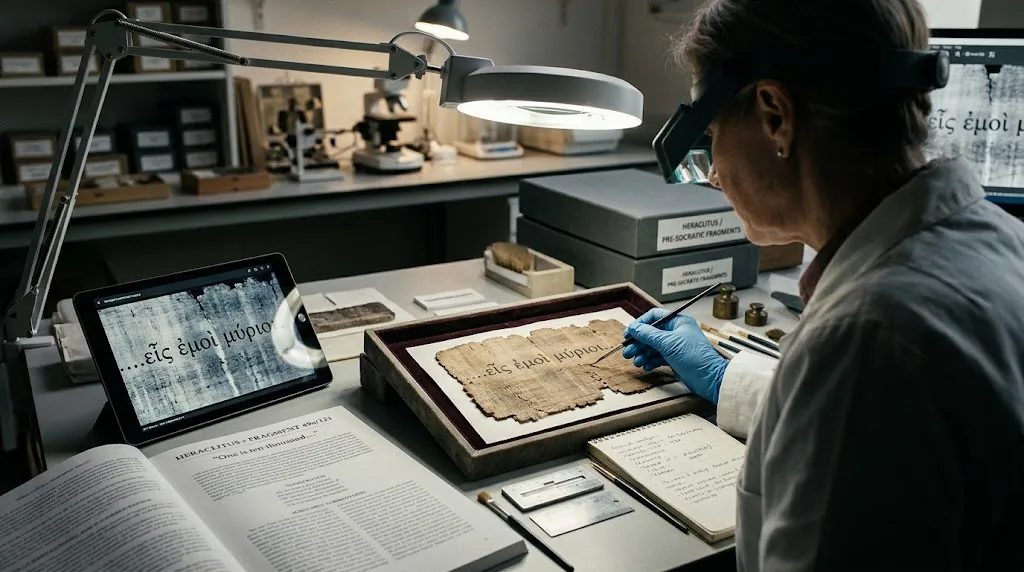
The authentic Heraclitus fragment most often brought into discussions of the warrior quote is commonly translated as “One man is ten thousand, if he is the best.” It offers a genuine connection to Heraclitus’s surviving philosophy, but it is not the same quotation as “Out of every 100 men, one is a warrior.”
What does “one man is ten thousand” mean?
The fragment suggests that one exceptional person may be worth more than a much larger group, depending on the quality or excellence being discussed.
A common English rendering is:
One man is ten thousand, if he is the best.
The phrase “ten thousand” should not necessarily be read as a literal calculation. In ancient Greek, the relevant term could convey the sense of a countless or very large number. The fragment’s emphasis is commonly understood as a comparison involving excellence rather than a mathematical claim.
Its precise interpretation remains open to scholarly discussion. For example, readers may ask what makes someone “the best”: superior judgment, wisdom, excellence in a particular activity, or some other quality. The short fragment does not settle every question.
What is the source of the fragment?
The fragment is included in modern collections of Heraclitus’s surviving sayings. Its numbering varies between editions, so a citation should identify the specific collection or translator rather than assuming every reference number is interchangeable.
The Diels–Kranz classification commonly identifies the saying as DK B49. Some other editions use different numbering; for example, a discussion of the fragment in Charles Kahn’s work identifies it as Fragment 63 in that edition. This is why source details matter. A reliable citation should include the translation or edition being used, particularly when scholars differ over wording or interpretation.
How is the authentic fragment different from the warrior quote?
The two sayings may seem related, but their wording and historical evidence are different.
| Comparison | “Out of every 100 men” quote | “One man is ten thousand” fragment |
| Historical attribution | Commonly attributed to Heraclitus online, without reliable ancient support | Preserved in collections of Heraclitus’s fragments |
| Documented source trail | A modern predecessor is associated with Tracers | Included in scholarly collections of ancient philosophical fragments |
| Main idea | A hierarchy of soldiers, fighters, and an exceptional warrior | The exceptional worth of one person, commonly interpreted in terms of excellence |
| Wording | Exists in multiple modern variations | A short saying with translation and interpretation differences |
| Appropriate citation | Cite the modern source trail and identify the uncertain authorship | Name the fragment collection or edition and translator |
The table highlights the central distinction: one saying has a documented modern source trail, while the other belongs to the surviving Heraclitus fragment tradition.
Does the authentic fragment validate the warrior quote?
No. The authentic fragment cannot be used as evidence that Heraclitus wrote the 100-men quotation. A modern saying might be inspired by an ancient idea, but inspiration is not authorship. Someone could expand the idea that one exceptional person is worth many others into a dramatic speech about soldiers. That would make the modern saying thematically related to the fragment, not an authentic quotation from Heraclitus.
The responsible approach is to cite each saying according to its own evidence. Use the fragment reference for the authentic philosophical statement and the modern source trail for the warrior quote.
How to Verify Heraclitus Quotes and Avoid Misattributions
You don't need to be a classics scholar to investigate a philosophical quotation. A few careful checks can help you distinguish an authentic fragment from a modern saying carrying an ancient name.
A practical five-step quote verification process
1. Search the exact wording. Search for the full quotation in quotation marks, then try distinctive phrases without quotation marks. Different versions may use different punctuation or wording, so check more than one form.
2. Find the earliest dated source you can verify. Look for books, newspaper archives, scholarly publications, or other dated records. Check whether the source actually contains the quotation or merely mentions it.
3. Check a reliable collection of the original philosopher’s writings. For Heraclitus, consult a scholarly collection of surviving fragments or a reputable translation. Look for a fragment number, the source through which it survives, and the edition used.
4. Compare translations and attributions. Ancient Greek can be translated in different ways. Determine whether differences reflect legitimate translation choices, a modern paraphrase, or an unsupported attribution.
5. Record exactly what the evidence establishes. Distinguish between a confirmed ancient quotation, a modern version inspired by an ancient idea, an earliest-known appearance, and a saying whose original author remains unknown.
Historical evidence helps clarify the quote’s origins. Heraclitus was active around 500 BCE, and approximately 100–125 fragments or texts associated with his philosophy survive, depending on the scholarly edition. However, no reliable ancient source connects him to the “Out of Every 100 Men” quotation. Quote investigator traces a likely predecessor to Tracers, a play performed Off-Broadway in 1984. By July 2003, a version of the saying was circulating online under Heraclitus’s name, but this later attribution does not establish that he wrote it. These dates help distinguish the ancient philosopher from the modern quotation’s documented history.
Applied to the warrior quote, this process points toward Tracers as a documented modern source and provides no reliable basis for treating Heraclitus as its author.
The same approach to critical thinking can be applied to philosophical questions about reality and perception. For example, the question “If a Tree Falls in a Forest, Does It Make a Sound?” explores how definitions, evidence, and interpretation can shape our understanding of a seemingly simple question. Just as quote verification requires separating documented facts from popular assumptions, philosophical inquiry encourages us to examine what a question actually means before accepting an answer.
Which sources are most reliable for ancient Greek quotations?
The strongest sources are generally those that explain where the wording comes from and allow readers to check it.
| Source type | How to use it |
| Scholarly editions of ancient texts | Check the original wording, fragment reference, and editorial notes. |
| Academic books and university publications | Understand the historical context and competing interpretations. |
| Primary historical references | Trace how a quotation or fragment was preserved and transmitted. |
| Reputable quotation investigations | Follow documented evidence about a saying’s circulation and attribution. |
| General quotation websites and social media | Discover popular versions, but verify their claims independently. |
““A quotation should be verified through its original source, not accepted simply because it appears beside a famous philosopher’s name.””
— Editorial guidance on verifying Heraclitus’s quotations and surviving philosophical fragments
Note on context: Because Heraclitus’s original work has not survived intact, researchers must examine fragment references, translations, historical context, and evidence of attribution | Key Takeaway Summary: Trace quotations to credible sources and distinguish authentic ancient fragments from modern sayings incorrectly attributed to Heraclitus
Key Takeaway: Trace quotations to credible sources and distinguish authentic ancient fragments from modern sayings incorrectly attributed to Heraclitus
- Search the exact wording; locate the earliest verifiable source
How to Apply This in Daily Life
- 1Reflect on this Stoic exercise each morning before starting your tasks.
- 2Apply the dichotomy of control when navigating unexpected setbacks or decisions.
- 3Journal your reflections in the evening to reinforce clarity and discipline.
Frequently Asked Questions
Concluding Thoughts
So, did Heraclitus say “Out of Every 100 Men”? The available evidence does not support attributing the quote to him. The documented modern source trail points to Tracers, a play about Vietnam veterans, with a related version recorded in a 1985 Associated Press report. Versions attributed to Heraclitus appeared in online discussion groups by 2003.
Heraclitus did write about war, conflict, and the value of exceptional understanding. His authentic fragment commonly translated as “one man is ten thousand” may help explain why the modern warrior saying seems philosophically compatible with his ideas. But thematic similarity is not historical proof. The most accurate approach is to distinguish the modern warrior quote from Heraclitus’s surviving fragments, cite the sources that support each claim, and acknowledge uncertainty where the evidence stops.
The takeaway: A quotation can express a powerful idea without belonging to the famous person whose name appears beneath it. When historical accuracy matters, follow the source rather than the attribution.

Hi, I’m Mehrab Khursheed, a professional Content Writer and Digital Marketing Expert with 4 years of experience in the digital industry. I studied at The Islamia University of Bahawalpur. I specialize in creating engaging, actionable content on practical Stoicism, mental resilience, personal growth, and philosophical frameworks for modern life.