

QuotesPublished Sep 24, 202627 min read

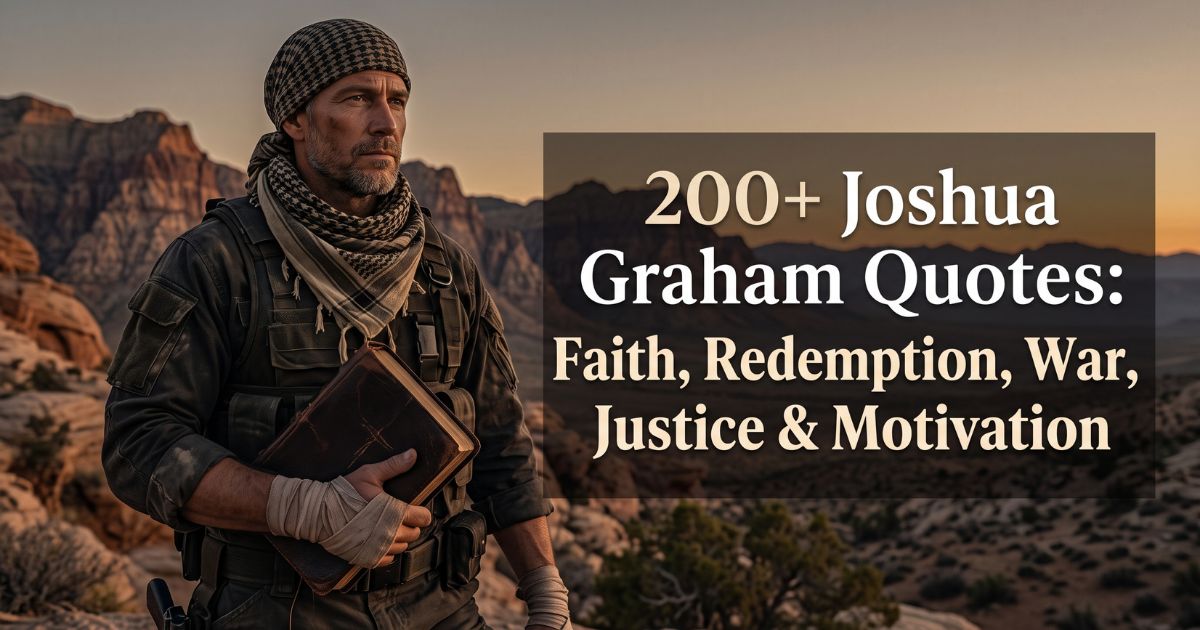
200+ Joshua Graham Quotes: Faith, Redemption, War, Justice & Motivation

If you’re searching for the best Joshua Graham quotes, you’ll find far more than memorable lines from Fallout: New Vegas. Joshua Graham’s dialogue explores powerful themes of faith, redemption, survival, justice, violence, and forgiveness. His words reveal the inner conflict of a man struggling to reconcile his past with his beliefs and sense of purpose.
This guide brings together memorable Joshua Graham quotes from Honest Hearts, along with their context and meaning. Whether you’re looking for famous quotes, motivational words, or deeper character insights, this collection explores what makes the Burned Man’s dialogue so memorable and why his words continue to resonate with Fallout fans.
200 joshua graham quotes faith redemption war justice and motivation

Who Is Joshua Graham? The Story Behind the Quotes

Joshua Graham is a fictional character from the Fallout universe who becomes a central figure in Fallout: New Vegas – Honest Hearts. He is also known by two names that explain much of his character: the Malpais Legate and the Burned Man.

His history is essential to understanding his dialogue.

Joshua Graham Before Honest Hearts

Before the events of Honest Hearts, Graham was associated with New Canaan and served as a missionary. His life changed dramatically after becoming involved with Edward Sallow, better known as Caesar.Graham eventually became Caesar's first Legate and one of the most formidable military leaders in Caesar's Legion. The character's official game history therefore creates an unusual contrast between religious service and military brutality.

Joshua Sawyer, who served as project director for Honest Hearts, has stated that he wrote Joshua Graham and Daniel while developing the expansion's story and characters. Sawyer also described religious themes as an intentional part of the expansion's design.
That background explains why Joshua Graham sayings often sound like a mixture of scripture, battlefield philosophy, and personal confession.

The Burned Man and His Survival

Graham's defeat at the First Battle of Hoover Dam led to his punishment by Caesar. The Honest Hearts introduction describes Caesar ordering Graham to be covered in pitch, set on fire, and thrown into the Grand Canyon. The story then follows rumors that he survived and became known throughout the wasteland as the Burned Man.
That experience becomes the foundation for many of the character's most memorable themes:
  • Survival after apparent destruction
  • Physical pain
  • Spiritual rebirth
  • Guilt
  • Revenge
  • Faith
  • Forgiveness
  • Responsibility
  • Identity
  • Redemption
The fire isn't merely a physical event. It becomes a symbol for the destruction of Graham's former identity.

Joshua Graham in Honest Hearts

In Honest Hearts, Graham is associated with the Dead Horses in Zion Canyon. The expansion places him in a conflict involving the White Legs, the Sorrows, Daniel, and the future of Zion. The official game description emphasizes that the player's decisions affect the fate of Zion, making Graham's moral choices part of the expansion's central conflict.

This setting allows his dialogue to explore a question that runs through almost everything he says:
Can someone who has committed terrible acts genuinely become a different person?
Graham doesn't answer that question simply.

Why Joshua Graham's Dialogue Is So Memorable

The writing works because Graham rarely speaks like an ordinary action-game character.
His dialogue combines:
  • Biblical imagery
  • Military language
  • Personal experience
  • Restrained threats
  • Religious conviction
  • Self-criticism
  • Moral argument
  • Dry confidence
His voice actor, Keith Szarabajka, provided Graham's performance in Honest Hearts. The result is a character whose words feel deliberate even when he's discussing violence.

    The Most Famous Joshua Graham Quotes

    The best Joshua Graham quotes are often remembered because they contain a contradiction.
    He can speak about God while preparing for war. He can discuss forgiveness while contemplating punishment. He can acknowledge his own sins without becoming passive.

    One of his most famous ideas is that the inner fire that helped him survive was stronger than the physical fire surrounding him. The line has become widely associated with Graham's character and is frequently used as an inspirational statement. Rather than treating famous lines as isolated motivational posters, it's more useful to understand what they mean inside the story.

    Famous Joshua Graham Lines

    Commonly remembered themes include:
    1. The rejection of fear.
    2. Faith after suffering.
    3. The burden of leadership.
    4. The importance of courage.
    5. The consequences of violence.
    6. The possibility of redemption.
    7. Responsibility for past actions.
    8. The destructive nature of hatred.
    9. Survival through inner conviction.
    10. The danger of uncontrolled revenge.
    11. Spiritual transformation after trauma.
    12. The conflict between mercy and justice.
    13. The importance of protecting one's community.
    14. The difference between forgiveness and weakness.
    15. The tension between divine justice and human judgment.

    Joshua Graham Speech Quotes

    Graham's longer speeches are especially effective because he doesn't simply tell the player what to think. He often presents a moral position and then exposes the tension inside it. His speeches about Daniel, the White Legs, Zion, God, and violence show that Graham sees the world through both religious and military frameworks. That combination produces some of the strongest Joshua Graham speech quotes in the Fallout series.

    Best Joshua Graham Quotes From Fallout: New Vegas

    Most of the character's substantial dialogue appears in Honest Hearts, where he becomes an active character rather than merely a name from the Mojave's history. The base game establishes Graham's reputation indirectly, while Honest Hearts reveals the person behind the legend.

    Best Joshua Graham Quotes From Honest Hearts

    The most important categories include:

    Theme

    What Graham's dialogue explores

    Faith

    Belief after suffering

    Redemption

    Whether a violent past can be overcome

    Survival

    Physical and spiritual endurance

    Justice

    When punishment becomes justified

    Revenge

    The danger of letting anger control action

    War

    The consequences of organized violence

    Forgiveness

    Choosing mercy without denying wrongdoing

    Responsibility

    Accepting the consequences of one's decisions

    Scripture

    Biblical language as moral framework

    Leadership

    Protecting people while making difficult choices

      Inspirational Joshua Graham Quotes About Life and Strength
      inspirational-joshua-graham-quotes-about-life-and-strength
      inspirational-joshua-graham-quotes-about-life-and-strength

      Some inspirational Joshua Graham quotes are popular because they sound like traditional motivational statements.Yet Graham's strength isn't presented as effortless confidence. His strength comes from surviving consequences.

      Quotes About Strength

      Graham's idea of strength is closely connected to endurance. He survives physical destruction, loses his home, carries the weight of his former life, and still continues moving forward.

      The important lesson isn't simply “be tough.”It's closer to this:
      Strength means continuing to act responsibly after suffering has changed you.
      That interpretation makes his dialogue more meaningful than a collection of generic motivational sayings.

      Quotes About Survival

      Survival appears repeatedly in Graham's story. His survival is physical, but it also becomes psychological and spiritual.
      His character represents several forms of survival:
      • Surviving loss
      • Surviving fear
      • Surviving guilt
      • Surviving violence
      • Surviving punishment
      • Surviving one's former identity
      • Surviving without abandoning purpose
      The famous fire imagery works because the character's survival isn't presented as random luck. It becomes part of his identity.

      Quotes About Hope

      Graham isn't optimistic in a conventional sense. He doesn't pretend that suffering will disappear. Instead, his worldview suggests that meaning can exist even when circumstances remain terrible. That distinction makes his quotes about hope particularly effective. Hope, in Graham's world, isn't necessarily believing everything will become easy. It's continuing to believe that actions still matter.

      Motivational Quotes

      For readers searching for Joshua Graham motivational quotes, the strongest themes are:

      1. Protect what matters.
      2. Keep moving after failure.
      3. Let conviction outlast fear.
      4. Use hardship as a reason to grow.
      5. Don't confuse mercy with weakness.
      6. Accept responsibility for the past.
      7. Don't let suffering completely define you.
      8. Remember that survival creates responsibility.
      9. Make future choices different from past mistakes.
      10. Control anger instead of becoming controlled by it.

        Joshua Graham Quotes About God, Faith and Scripture

        Faith is arguably the most important dimension of Graham's character. His religious language isn't decorative. It shapes how he understands suffering, morality, violence, forgiveness, and death.

        Quotes About God

        Graham frequently interprets events through his belief in God. That perspective gives his dialogue a distinctive quality because ordinary battlefield questions become spiritual questions. When Graham discusses violence, for example, he isn't merely asking whether something is tactically effective. He is also asking whether the action can be morally justified.

        Biblical and Scripture Quotes

        The game deliberately incorporates biblical references and themes into Graham's dialogue. Fallout references connected to Honest Hearts include biblical ideas involving forgiveness, baptism, the prodigal son, Moses, Cain, and other scriptural imagery. This is one reason searches for Joshua Graham biblical quotes and Joshua Graham Bible quotes remain popular.

        However, readers should distinguish between three things:
        1. Those aren't interchangeable.
        2. A direct quotation from the Bible.
        3. Graham quoting or adapting biblical language.
        4. Graham expressing an original idea using biblical imagery.

        Joshua Graham and Psalm 137

        Psalm 137 is particularly important when discussing Graham's religious dialogue. The Psalm deals with exile, grief, remembrance, anger, and revenge. Those themes fit Honest Hearts unusually well because Graham's story revolves around the destruction of New Canaan and the displacement of its survivors. The biblical material therefore reinforces the expansion's broader themes rather than functioning as random religious decoration.

        Mormon and Missionary Background

        Joshua Graham is portrayed as a New Canaanite missionary, and his religious background is central to his identity. The character's missionary experience also helps explain why he is capable of communicating religious ideas while simultaneously functioning as a military leader. That contradiction is intentional. Graham isn't simply “the religious Fallout character.” He's a character whose religious identity exists alongside a violent history.

        Quotes About Faith

        The most significant Joshua Graham quotes about faith revolve around:

        • Belief after suffering
        • Baptism
        • Divine judgment
        • Repentance
        • Grace
        • Forgiveness
        • Spiritual rebirth
        • God's children
        • Religious duty
        • The afterlife
        One particularly important short excerpt is:

        I have been baptized twice, once in water, once in flame.

        The power of the line comes from its double meaning. Water represents religious baptism, while flame refers to the event that physically transformed Graham into the Burned Man.

          Joshua Graham Quotes About Redemption and Forgiveness

          Redemption is where Graham becomes more complicated than a typical revenge-driven character. His past doesn't disappear. Instead, he has to decide what to do with it.

          Quotes About Redemption

          Graham's redemption is not presented as an easy emotional reset. He was responsible for enormous violence as a Legate. Becoming a missionary doesn't erase those actions. That makes his story closer to atonement through responsibility than simple forgiveness.

          His redemption can be understood through three stages:

          Past: He embraced violence and power.
          Fall: His military failure led to brutal punishment.
          Aftermath: He attempts to build a different identity while still retaining some of his old instincts.

          Quotes About Forgiveness

          Graham's attitude toward forgiveness is complicated. He believes forgiveness has value, but he doesn't interpret it as unlimited tolerance. That distinction is central to understanding him. For Graham, forgiveness doesn't necessarily mean pretending wrongdoing never happened. It can mean refusing to let wrongdoing determine every future action.

          Quotes About Grace

          Grace is especially important because Graham sees himself as someone who has received mercy despite his past. His religious worldview allows him to regard himself as both a sinner and someone capable of being saved. That tension makes his character more interesting than a simple hero transformation.

          Second Chances

          Graham's story is essentially a second-chance narrative. But the game doesn't make that second chance comfortable.He still carries:
          • Anger
          • Memories
          • Military instincts
          • Guilt
          • Responsibility
          • Fear of repeating history

          That is why Joshua Graham quotes about second chances resonate with readers who are interested in redemption rather than simple success.

          Redemption vs. Revenge

          The strongest conflict in Graham's story is not simply good versus evil. It's redemption versus revenge. Revenge says:
          They hurt us, so they deserve to suffer.
          Redemption asks:
          What kind of person will I become because they hurt us?
          Graham constantly approaches the boundary between these two ideas.

            Joshua Graham Quotes About Fire, Darkness and Survival
            joshua-graham-quotes-about-fire-darkness-and-survival
            joshua-graham-quotes-about-fire-darkness-and-survival
            Fire is probably the defining image associated with Joshua Graham. The Burned Man survived an execution designed to erase him.

            Quotes About Fire

            Fire represents several things simultaneously:
            • Punishment
            • Transformation
            • Pain
            • Survival
            • Purification
            • Trauma
            • Spiritual rebirth

            That is why fire-related Joshua Graham quotes are often interpreted as motivational lines. But their original context is darker. The character isn't describing an ordinary obstacle. He's talking about an event that nearly killed him.

            Quotes About Darkness

            Darkness in Graham's dialogue can represent fear, uncertainty, evil, grief, and moral confusion. His philosophy doesn't assume that darkness automatically disappears. Instead, his faith gives him a framework for moving through it.

            The Burned Man as a Symbol

            The nickname “Burned Man” represents more than physical scars. It separates Graham's old identity from his new one. The Malpais Legate represented Caesar's military machine. The Burned Man represents the survivor who emerged from its destruction.

            The transformation is therefore symbolic:
            Legate → failure → punishment → survival → missionary-warrior identity

            Quotes About Survival

            Graham's survival philosophy can be summarized as a refusal to let suffering become the final definition of a person. That idea explains why his dialogue works so well as motivational material. The context is brutal, but the underlying lesson is broadly relatable: failure, pain, and loss don't have to determine every future decision.

              Joshua Graham Quotes About War, Killing and Violence

              Graham's relationship with violence is one of the most controversial aspects of his character. He isn't a pacifist. He doesn't pretend to be one.

              Quotes About War

              Graham understands war from experience. He knows what military campaigns require, what happens when leaders lose control, and how violence affects communities. His dialogue therefore carries a practical understanding of warfare rather than an abstract one.

              Quotes About Killing

              One short line captures his complicated attitude toward killing:

              I don't enjoy killing, but when done righteously, it's just a chore.

              That sentence is important because it demonstrates Graham's moral framework without making him morally simple. He separates enjoyment from perceived duty. That distinction doesn't automatically make his actions morally correct. Instead, it reveals how Graham justifies violence to himself.

              Quotes About Violence

              Graham's violence is usually connected to protection, punishment, or war. The question is whether those justifications are reliable. That's where the character becomes morally ambiguous.

              His story invites the player to ask:
              When does protection become revenge?

              Quotes About Revenge

              Revenge is one of Graham's greatest weaknesses. His anger toward the White Legs can be understood through his history, but the game doesn't require the player to accept every violent impulse he has. His desire for retaliation can protect his people while simultaneously threatening to consume his judgment.

              Warrior Quotes

              Graham's warrior identity is impossible to separate from his missionary identity. He is both. That's what makes his dialogue distinctive. A conventional warrior might speak primarily about victory. A conventional missionary might speak primarily about mercy. Graham speaks about both, often within the same conversation.

                Joshua Graham Quotes About Justice, Morality and Responsibility

                Justice is another major theme in Graham's dialogue. His problem is that he sometimes struggles to separate justice from vengeance.

                Quotes About Justice

                Graham believes wrongdoing should have consequences. His interpretation of justice, however, is shaped by his religious convictions and military experience.

                This creates a recurring tension:
                Who has the authority to decide what punishment is justified?

                Quotes About Morality

                Graham's morality isn't based simply on “never use violence.” Instead, he evaluates actions through intention, responsibility, faith, and consequences. That framework can produce difficult decisions. The player isn't always given an obvious moral answer.

                Quotes About Responsibility

                Responsibility is one of the strongest ideas in Graham's story. His past cannot be erased. Even after changing his life, he remains accountable for what he previously did. This is why his redemption feels more credible than a simple declaration that he has become good.

                Justice vs. Revenge

                Justice attempts to restore order. Revenge attempts to answer pain with pain. Graham often stands between them. His most interesting moments occur when he has the opportunity to choose one over the other.

                Mercy, Restraint and Consequences

                The endings of Honest Hearts demonstrate this conflict particularly well. Depending on the player's choices, Graham can remain committed to militant resistance while also changing through the decision to spare Salt-Upon-Wounds. The ending explicitly describes his wrath being restrained and notes that sparing his enemy changed him. That is one of the clearest examples of the game's argument that mercy can change the person offering it.

                  Best Joshua Graham Quotes for Bad Times and Motivation

                  If you're searching for Joshua Graham quotes for inspiration, the most useful approach is to look beyond isolated lines. His character provides several motivational themes.

                  Quotes for Difficult Times

                  Graham's story suggests that difficult circumstances don't automatically justify destructive behavior. Pain explains a person's choices. It doesn't necessarily excuse them.

                  Quotes About Inner Strength

                  His inner strength comes from conviction. He has suffered physically, emotionally, and spiritually, yet he continues to act according to a purpose. That makes his story useful for readers interested in resilience.

                  Quotes About Darkness and Hope

                  Graham's hope isn't cheerful. It's stubborn. He believes there is meaning beyond immediate circumstances, even while living in an extremely violent world. That makes his dialogue more believable than conventional motivational language.

                  Badass Quotes

                  For readers looking for Joshua Graham badass quotes, the strongest material usually involves:

                  • Fearlessness
                  • Controlled threats
                  • Military confidence
                  • Survival
                  • Determination
                  • Personal conviction
                  • Refusal to surrender
                  But the context matters. Some lines sound “badass” when isolated because Graham speaks calmly about violence. Within the story, those same lines can reveal his unresolved anger.

                  Short Quotes for Captions

                  For captions, the most effective Graham-inspired ideas are short themes such as:
                  • Survive the fire
                  • Choose conviction over fear
                  • Strength after suffering
                  • Redemption requires responsibility
                  • Mercy isn't weakness
                  • Don't become your past
                  • Faith after failure
                  • Control revenge
                  • Protect what matters
                  • Let hardship refine you

                  These are interpretive themes, not presented as verbatim Graham dialogue.

                    Top 10 Joshua Graham Quotes Explained

                    1. The Fire and Survival Theme

                    Graham's famous fire imagery represents survival after apparent destruction. The deeper message is not simply “be strong.” It's about finding an internal reason to continue when external circumstances become unbearable.

                    2. The Redemption Theme

                    Graham's past as the Malpais Legate gives his redemption story weight. A person with no serious past wrongdoing wouldn't need redemption. Graham does.

                    3. The Violence and Restraint Theme

                    His attitude toward violence demonstrates that he doesn't consider killing inherently pleasurable. Instead, he attempts to place violence inside a moral framework. The uncomfortable question is whether that framework is sufficient.

                    4. The Fire and Transformation Theme

                    The burning that created the Burned Man also symbolically destroys Graham's former identity. His scars become reminders of what he survived and what he used to be.

                    5. The Justice Theme

                    Graham believes wrong actions deserve consequences. But his story demonstrates that justice becomes dangerous when anger takes control.

                    6. The Responsibility Theme

                    One of Graham's strongest character lessons is that changing your life doesn't erase your past. Redemption requires acknowledging responsibility.

                    7. The Forgiveness Theme

                    Forgiveness doesn't mean forgetting wrongdoing. For Graham, forgiveness becomes a way to avoid allowing anger to control every future decision.

                    8. The Faith Theme

                    Graham's faith gives him a framework for interpreting suffering. Biblical references make his dialogue feel like the language of someone trying to understand a violent world through religious belief.

                    9. The War Theme

                    His experience as a military commander means he understands war differently from someone who has only observed it. That experience also makes his later opposition to certain forms of violence more complicated.

                    10. The Strength and Change Theme

                    Ultimately, Graham's strongest message is about change. He isn't compelling because he was always good. He's compelling because he wasn't.

                      Joshua Graham Quotes by Theme: Quick Reference

                      Theme

                      Core idea

                      Why it matters

                      Faith

                      Belief after suffering

                      Gives Graham purpose

                      Redemption

                      Becoming different from your past

                      Defines his character arc

                      Fire

                      Survival and transformation

                      Explains the Burned Man

                      War

                      Violence and consequences

                      Connects his past and present

                      Justice

                      Punishment and moral authority

                      Creates conflict

                      Revenge

                      Anger after loss

                      Challenges his judgment

                      Forgiveness

                      Choosing what happens next

                      Supports his transformation

                      Strength

                      Endurance through hardship

                      Makes his story motivational

                      Scripture

                      Biblical moral language

                      Shapes his worldview

                      Responsibility

                      Accepting one's past

                      Prevents simplistic redemption

                      Hope

                      Meaning beyond suffering

                      Gives his faith emotional weight

                      Leadership

                      Protecting others

                      Explains his role in Zion

                        Joshua Graham Quotes: Character and Theme Comparison

                        Joshua Graham vs. The Burned Man

                        These names describe two stages of the same person. Joshua Graham emphasizes his identity as a man, missionary, leader, and former Legate. The Burned Man emphasizes his legend. The distinction matters because Graham himself lives between those identities.

                        Missionary vs. Warrior

                        Graham's missionary and warrior identities aren't separate chapters that never overlap. They influence one another. His military background shapes how he approaches threats. His faith shapes how he interprets violence. That combination creates the unusual tone associated with his religious quotes.

                        Redemption vs. Revenge

                        Redemption asks Graham to become something better. Revenge pulls him toward the instincts of his former self. The conflict between these two forces is arguably the emotional core of his character.

                        Joshua Graham and Other Fallout Characters

                        Graham also stands apart from many other Fallout: New Vegas characters because his story is built around an explicit moral transformation. The Mojave is full of factions competing for power, but Graham's conflict is more personal. His primary enemy isn't only another faction. It's the possibility that his old self never truly disappeared.

                          What Makes Joshua Graham's Quotes So Powerful?
                          what-makes-joshua-grahams-quotes-so-powerful
                          what-makes-joshua-grahams-quotes-so-powerful

                          Contrasting Faith With Violence

                          The biggest reason Graham's dialogue stands out is contradiction. He talks about God while discussing war. He talks about forgiveness while carrying anger. He values mercy while possessing exceptional combat ability. Those contradictions make the character feel more human.

                          Personal History Gives the Words Weight

                          A motivational statement means more when the speaker has suffered through the subject. Graham has firsthand experience with war, punishment, survival, loss, and leadership. His words therefore come with narrative history attached.

                          Strong Biblical and Symbolic Imagery

                          Fire, baptism, darkness, light, judgment, sin, forgiveness, and salvation give Graham's dialogue a symbolic vocabulary. These concepts also allow readers to interpret his words at multiple levels.

                          Moral Ambiguity

                          Graham isn't designed to be a flawless hero. He has committed serious wrongdoing. He has genuine compassion. He can be ruthless. He believes in forgiveness. He can also advocate extreme violence. That ambiguity is precisely what makes his quotes worth analyzing.

                          Dialogue and Voice Performance

                          Keith Szarabajka's performance contributes heavily to Graham's identity. He voiced the character in Honest Hearts, and Joshua Sawyer has discussed keeping Szarabajka in the casting process and later regarding the performance as an excellent decision. The delivery is restrained rather than theatrical. That calmness makes Graham's threatening lines more effective.

                            200+ Joshua Graham Quote Themes and Ideas to Explore

                            The following are paraphrased themes rather than verbatim game dialogue. They provide a broader reference for readers who want to understand the range of Graham's sayings without reproducing the game's script.

                            Faith and God

                            1. Faith after suffering
                            2. Trusting God during hardship
                            3. Divine judgment
                            4. Spiritual rebirth
                            5. Religious duty
                            6. God's children
                            7. Sacred places
                            8. Faith versus fear
                            9. Faith versus anger
                            10. Prayer and action
                            11. Sin and salvation
                            12. Grace after wrongdoing
                            13. The meaning of baptism
                            14. Religious responsibility
                            15. Spiritual endurance
                            16. Belief after trauma
                            17. Judgment after death
                            18. The purpose of suffering
                            19. Religious conviction
                            20. Hope beyond the physical world

                            Redemption and Forgiveness

                            1. Accepting a violent past
                            2. Changing after failure
                            3. Earning forgiveness
                            4. Giving forgiveness
                            5. Second chances
                            6. Atonement
                            7. Personal transformation
                            8. Leaving an old identity behind
                            9. Learning from failure
                            10. Responsibility after repentance
                            11. Mercy without weakness
                            12. Forgiveness without forgetting
                            13. Rebuilding trust
                            14. Becoming worthy of another chance
                            15. Resisting hatred
                            16. Choosing a different future
                            17. Breaking cycles of violence
                            18. Accepting consequences
                            19. Spiritual healing
                            20. Moral recovery

                            Fire and Survival

                            1. Surviving physical destruction
                            2. Inner fire
                            3. Fire as transformation
                            4. Fire as punishment
                            5. Fire as purification
                            6. Pain as memory
                            7. Surviving impossible circumstances
                            8. Enduring fear
                            9. Continuing after loss
                            10. Rebuilding after destruction
                            11. Becoming stronger through hardship
                            12. Physical scars
                            13. Emotional scars
                            14. Survival with purpose
                            15. Refusing surrender
                            16. Endurance under pressure
                            17. Rising after defeat
                            18. Living with trauma
                            19. Turning pain into purpose
                            20. Becoming someone new

                            War and Violence

                            1. The cost of war
                            2. Military discipline
                            3. Violence as duty
                            4. Violence as revenge
                            5. Killing without hatred
                            6. Protection through force
                            7. War against enemies
                            8. The danger of cruelty
                            9. Battlefield leadership
                            10. Combat experience
                            11. Strategic thinking
                            12. Military responsibility
                            13. Protecting civilians
                            14. Defending territory
                            15. The burden of command
                            16. Warrior discipline
                            17. Controlled aggression
                            18. Destructive anger
                            19. The morality of killing
                            20. The consequences of war

                            Justice and Morality

                            1. Justice versus vengeance
                            2. Moral responsibility
                            3. Punishment
                            4. Consequences
                            5. Personal accountability
                            6. Protecting innocent people
                            7. Moral authority
                            8. Restraint
                            9. Mercy
                            10. Fair judgment
                            11. Religious morality
                            12. Ethical leadership
                            13. Responsibility for others
                            14. Justice under pressure
                            15. Anger versus reason
                            16. Compassion versus punishment
                            17. Law versus morality
                            18. Revenge versus justice
                            19. Moral compromise
                            20. Choosing the lesser evil

                            Strength and Motivation

                            1. Inner strength
                            2. Mental toughness
                            3. Courage
                            4. Determination
                            5. Persistence
                            6. Discipline
                            7. Surviving failure
                            8. Recovering from defeat
                            9. Facing fear
                            10. Continuing forward
                            11. Staying committed
                            12. Protecting your values
                            13. Refusing hopelessness
                            14. Finding meaning
                            15. Building resilience
                            16. Enduring criticism
                            17. Facing consequences
                            18. Learning from mistakes
                            19. Staying focused
                            20. Acting despite fear

                            Hope and Life

                            1. Hope after destruction
                            2. Meaning after suffering
                            3. Finding purpose
                            4. Protecting the future
                            5. Believing in change
                            6. Starting again
                            7. Choosing life
                            8. Finding peace
                            9. Accepting uncertainty
                            10. Moving beyond the past
                            11. Creating a better future
                            12. Faith in difficult circumstances
                            13. Finding purpose through service
                            14. Helping others
                            15. Protecting a community
                            16. Hope through faith
                            17. Courage during uncertainty
                            18. Emotional endurance
                            19. Spiritual hope
                            20. Life after trauma

                            Leadership

                            1. Leading under pressure
                            2. Protecting followers
                            3. Taking responsibility
                            4. Making difficult choices
                            5. Inspiring loyalty
                            6. Understanding fear
                            7. Strategic leadership
                            8. Military leadership
                            9. Spiritual leadership
                            10. Community protection
                            11. Leadership through example
                            12. Accepting criticism
                            13. Controlling anger
                            14. Knowing when to fight
                            15. Knowing when to show mercy
                            16. Protecting the vulnerable
                            17. Making sacrifices
                            18. Bearing consequences
                            19. Guiding others
                            20. Choosing responsibility over comfort

                            The Burned Man

                            1. Surviving Caesar's punishment
                            2. The destruction of an identity
                            3. Becoming a legend
                            4. Living after execution
                            5. Physical scars as symbols
                            6. The legend versus the person
                            7. Fear surrounding the Burned Man
                            8. Graham's reputation
                            9. The mystery of survival
                            10. Returning from exile
                            11. The past following a person
                            12. Rebuilding identity
                            13. Becoming more than a nickname
                            14. Living with history
                            15. Turning trauma into strength
                            16. The symbolism of fire
                            17. Death and rebirth
                            18. Reputation and reality
                            19. Legend versus humanity
                            20. Survival as transformation

                            Zion and the Tribes

                            1. Protecting Zion
                            2. The Dead Horses
                            3. The Sorrows
                            4. The White Legs
                            5. New Canaan
                            6. New Canaanite identity
                            7. Tribal survival
                            8. Cultural conflict
                            9. Protecting sacred land
                            10. Community loyalty
                            11. The destruction of New Canaan
                            12. Displacement
                            13. Tribal alliances
                            14. The future of Zion
                            15. Daniel's pacifism
                            16. Graham's militancy
                            17. The conflict between approaches
                            18. Protecting a people
                            19. Choosing exile or resistance
                            20. Building a future after destruction

                            The Most Important Final Themes

                            1. Faith does not erase the past.
                            2. Survival creates responsibility.
                            3. Redemption requires action.
                            4. Forgiveness can require strength.
                            5. Revenge can distort justice.
                            6. Violence can become an identity.
                            7. Leadership carries consequences.
                            8. Suffering can change a person without defining the rest of their life.
                            9. Mercy can interrupt a cycle of violence.
                            10. The past matters, but it doesn't have to control every future decision.

                            These 210 themes are useful because they show why Joshua Graham sayings continue to attract readers even years after Honest Hearts was released.

                              Frequently Asked Questions

                              Concluding Thoughts

                              The appeal of Joshua Graham quotes isn't simply that they sound tough or inspirational. It's that almost every important idea surrounding Graham contains a contradiction. He is a missionary who became a warrior. A violent man who seeks redemption. A believer who struggles with revenge. A survivor who carries the scars of his former identity. A leader who understands both mercy and brutality. That complexity gives his dialogue lasting power. 

                              The most valuable lesson from Graham's story isn't that suffering automatically makes someone stronger. It's that what a person chooses after suffering matters. His story also shows why context matters when reading famous game quotes. A line about strength can come from a story about trauma. A statement about justice can hide a struggle with revenge. A religious passage can exist alongside extreme violence. That is what makes Graham more than a collection of memorable sayings. 

                              He's a character built around the difficult question of whether a person can survive their past without becoming trapped inside it. And perhaps that's why his words continue to resonate with Fallout: New Vegas fans: redemption isn't presented as forgetting who you were. It's presented as deciding who you'll become next

                              Sources

                              • Bethesda/Steam's official Fallout: New Vegas – Honest Hearts listing confirms the expansion's developer, publisher, release information, Zion setting, and central conflict.
                              • Fallout Wiki provides background on Graham's history, the Burned Man, and the Honest Hearts introduction.
                              • Joshua Sawyer's documented development information identifies him as the writer of Joshua Graham and explains the expansion's religious themes.
                              • Fallout Wiki documents biblical themes and references associated with Graham's dialogue.
                              • Keith Szarabajka is credited as Joshua Graham's voice actor.

                               
                              Share this biblical study:
                              Mehrab Khursheed
                              Written by

                              Mehrab Khursheed

                              Author & Contributor
                              View Author Profile

                              Mehrab Khursheed is the primary author and contributor at WisdomNest, dedicated to sharing thoughtful biblical insights, Scripture studies, and practical guidance for everyday faith.